
Most brokers learn the hard way. They mortgage their house, sign a five-year lease, and pray agents show up. That is not a strategy. That is a gamble.
When I sat down with Wayne Einhorn brokerage coaching consulting expert, for a recent episode of Realizations, he told me something that stopped me cold.
His banker once slid a stack of papers across the table and said, "You're bankrupt." Wayne was 30 years old. The lights were still on. His agents still came to work. But the math did not lie.
His approach to broker coaching systems in real estate starts with understanding the numbers, not hiding from them.
Why I Brought Wayne Einhorn Brokerage Coaching Consulting Into This Conversation
Brokerage leadership is one of the most misunderstood jobs in real estate. Everyone thinks they can run an office. Very few actually can.
Wayne does not coach agents. He coaches the people who hire agents. That is a completely different skill set. And after 28 years in this business, through four economic downturns, I know the difference between a broker and a leader.
Read more of Andrea Gordon's real estate insights on building sustainable careers in volatile markets.
According to the National Association of Realtors 2024 Member Profile, the typical brokerage operates on thin margins, with many owners reporting less than 10 percent net profit before owner compensation.
Wayne Einhorn’s Story: From Bankruptcy to Brokerage Mastery
Wayne has been in real estate for 41 years. His brokerage career mirrored his sales career. That meant he failed miserably for the first three years.
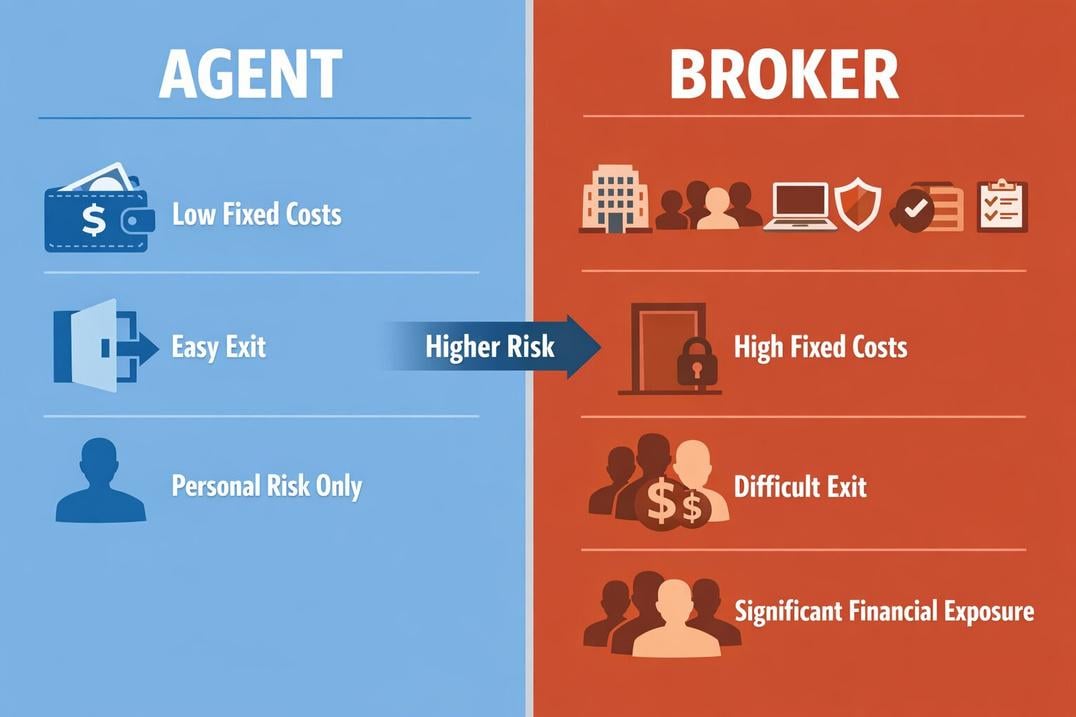
Failing as a broker is different than failing as an agent. Agents have low fixed costs. They can walk away. Brokers have leases, payroll, and debt.
"My banker looked at me and said, 'You're bankrupt.' I was 30 years old. The lights were still on. My agents still came to work. But he put all the papers out on the table and showed me the math. That moment changed everything. I never wanted anyone to have to go through that again. I figured out the secret sauce of being successful, and I thought if I could show other brokers the secret sauce, they wouldn't have to go through the trials and tribulations that I did."–
He figured out the secret sauce. Then he realized brokerage is a lonely business. There is no school for brokers. No one teaches you how to operate a profitable brokerage. The National Association of Realtors once had a program called CRB with some courses on profitability, but Wayne has not seen meaningful education since.
That gap became his life's work.
Learn more about Wayne Einhorn's brokerage coaching approach and how he helps brokers avoid common pitfalls.
Why Brokerage Is the Hardest Business in Real Estate
Here is what most agents do not understand. A brokerage has high fixed costs. An agent has almost none.
An agent wakes up tomorrow and decides where to buy their real estate services. A broker wakes up and owes money before the first phone call rings.
There is no formal education system for brokers. You learn by bleeding. Most brokerages struggle because the owner was a great agent who wanted a greater commission split. That is not a business plan. That is a recipe for bankruptcy.
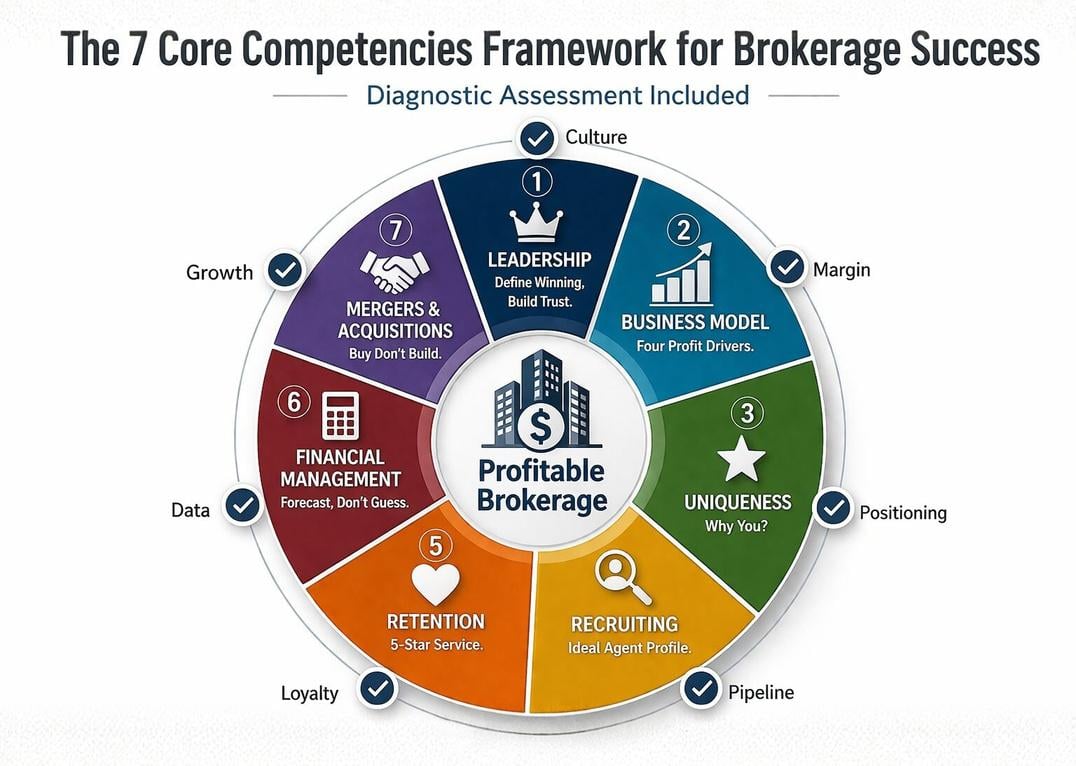
The 7 Core Competencies of a Profitable Brokerage (Wayne Einhorn Framework)
Wayne does not believe in silver bullets. He believes in systems.
After 41 years in real estate, including his own painful bankruptcy at age 30, he realized something critical. Most brokers fail not because they are bad at real estate. They fail because they are missing pieces of a larger puzzle. They focus on recruiting agents but ignore financial management. They build a brand but have no leadership framework. They chase growth without a profitable business model.
His framework rests on seven core competencies. Think of them as seven legs on a stool. If one leg is shorter than the others, the whole thing wobbles. If two are missing, the stool collapses.
"If you're not strong in all seven competencies, you won't have a scalable, profitable brokerage. The most common one that most people have heard about is recruiting and retention. That's important. Those are two of the seven competencies. But there are five others. If we don't have prowess in all seven strategic areas of the business, then we're not going to have a profitable, scalable brokerage. It starts with leadership. Where are we going to take the brokerage? And how is it going to serve our constituents?"–
Wayne recently expanded on these seven competencies, explaining how they apply specifically to low-transaction markets.
Let me walk you through each competency in detail. For each one, I have included diagnostic questions to help you assess your own brokerage, red flags that indicate weakness, and first action steps you can take today.
Competency 1: Leadership
Effective leadership focuses on creating an environment where agents feel valued and excited to stay. It’s not about being the smartest person in the room. It is about creating an environment where agents want to stay. The number one purpose of a brokerage is to have agents excited to pay the commission.
Real estate leadership training for brokers starts with answering three questions for every agent: what does winning look like here, who has my back when things go wrong, and can I grow here?
Explore Andrea Gordon's perspective on real estate leadership and why emotional intelligence separates good brokers from great ones.
Competency 2: Business Model and Profitability
Profitability results from four key drivers: agent count, production per agent, cost structure, and retention rate. Understanding your breakeven point and average production per agent is crucial for managing finances effectively. If you wait until tax time to review your P&L or are unaware of which agents are profitable, you're merely guessing.
Real estate brokerage profitability depends on knowing your exact breakeven point. Do you know yours? If the market dropped 20 percent tomorrow, how many months could you operate before running out of cash?
Check your last three months of P&L statements; if your net profit margin is below 15%, it's a sign of trouble. Identify the bottom 20% of agents by production, as they may be costing you money. A robust business model allows for investment in recruitment, retention, and acquisitions.
For brokers ready to master this competency, Wayne offers a comprehensive profitability course that includes live Q&A sessions, evergreen learning modules, and access to a private community of broker owners.
|
Driver |
Impact |
|
Agent Count |
Revenue scale |
|
Production Per Agent |
Margin growth |
|
Cost Structure |
Profit stability |
|
Retention Rate |
Long-term sustainability |
Competency 3: Uniqueness
"Me too" brokerages struggle as they compete on commission splits, leading to a price-driven race. To stand out, brokerages must clearly articulate their unique value proposition. If agents can't describe this uniqueness in one sentence, it's time to reassess.
Focus on three strengths that set your brokerage apart, rank them with input from agents, and create a one-page document highlighting the top strength. Use this in recruiting conversations. Successful brokerages build uniqueness based on what agents value, not just the owner's preferences.
Competency 4: Recruiting
Recruiting should not focus on quantity but rather on quality. Lowering standards leads to unproductive agents who leave quickly. Establish an ideal agent profile and track recruiting conversations. Identify patterns among your top agents to target competitors effectively. Dedicate time each week to recruiting, similar to a listing appointment. Remember, successful recruiting must also prioritize retention, as fitting agents into your culture is essential.
Recruiting is not about signing everyone who walks through the door. Lowering standards to grow headcount brings agents who produce little, complain often, and leave quickly. Effective brokerage recruiting and retention strategies start with knowing exactly who you want.
Competency 5: Retention
Retention is crucial for profitability, as replacing an agent costs three to five times more than keeping them. Agents often leave due to a lack of support or recognition rather than money. Treating agents like valued customers is essential, as they have choices for real estate services. Assess your twelve-month retention rate and engage with your top ten agents regularly to mitigate risk.
Brokerage recruiting and retention strategies work together. Recruiting without retention is a leaky bucket. The best recruiters recruit agents who actually fit their culture. Successful brokerages typically maintain retention rates above 85 percent.
Wayne Einhorn brokerage coaching consulting hosts a members-only event exploring how profitability and customer experience intersect, helping brokers elevate service and strengthen their brand.
Read more about building agent loyalty in competitive markets on Andrea's blog.
Competency 6: Financial Management
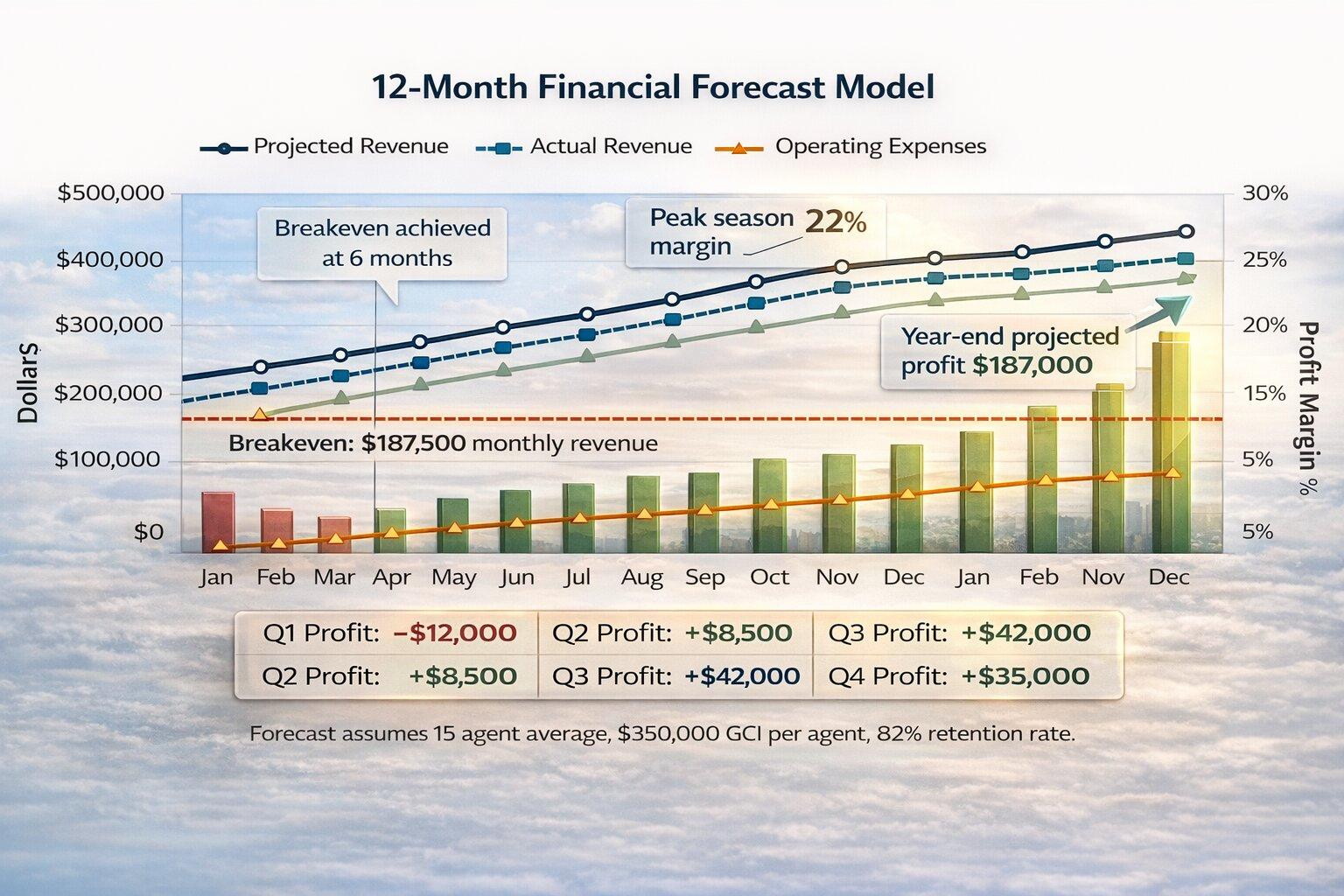
Forecasting should not be confused with guessing; many brokers rely on guesses. Track key metrics monthly, such as gross commission income, operating expenses, and retention rate. A proper forecast is a planning tool that models cash flow scenarios. If you lack a twelve-month cash flow forecast or monitor your bank balance only at payroll time, you're at risk.
Calculate fixed monthly expenses and divide by the average commission per transaction to determine the necessary monthly deals for breakeven. If this number increases, you may face issues. Effective financial management enables informed investment decisions and understanding of a brokerage's worth.
Broker coaching systems in real estate emphasize tracking these metrics monthly: gross commission income, operating expenses, net profit, cash on hand, agent count, average production per agent, and retention rate.
Competency 7: Mergers and Acquisitions
Starting a brokerage from scratch is risky. Wayne calls it a "green field startup." Instead, he advises brokers to buy existing brokerages.
"There are so many brokers today that need to sell, but have profitable businesses. I've got people who would give their brokerage to the right person because they've made all their money. They're financially beyond successful. The brokerage is worth millions of dollars, but it's not a significant part of their net worth. They just want the right person to take it over as a legacy thing because they've got all these people, hundreds of people that they've serviced their whole lives. They have relationships with them. They don't want to be the last guy who shuts off the lights."–
Acquisition isn't just for large companies; it allows you to quickly gain market share by buying an existing brokerage and retaining most agents. Instead of spending years building a team, you can acquire a brokerage with fifty agents in six months. If you haven't considered acquisition as a growth strategy, you're missing a key opportunity in real estate.
Identify three brokerages owned by individuals over 60 and research their agent count. Start by building relationships, not pitching a sale, to facilitate future acquisition discussions. Learning how to scale a real estate brokerage often means acquiring an existing book of business, retaining most agents, eliminating a competitor, and gaining market share overnight.
Research from McKinsey on real estate brokerage models suggests that firms with systematic operational frameworks outperform peers by significant margins during market downturns.
Explore Andrea Gordon's perspective on real estate leadership and why emotional intelligence separates good brokers from great ones.
Browse Inner Circle Broker Coaching resources for deeper leadership training materials, including competency assessment tools.
Knowing how to scale a real estate brokerage means mastering all seven. Most brokers are strong in one or two areas.
The Future of Real Estate Brokerages According to Wayne Einhorn
Wayne is a business geek. He studies companies. He watched Expedia try to kill travel agents. Fifteen years ago, he booked hotels through third-party sites. Today, he uses his Bonvoy or Hilton app exclusively.
Marriott and Hilton won by building customer service protocols that blew Expedia out of the water. They got the customer back.
Real estate can do the same thing.
"The missing link in real estate isn't technology. It's relationships. People want relationships. Even millennials coming up through the ranks, they love to transact digitally, but it's still the largest transaction they have ever made. Zillow is what Expedia was 20 years ago. Marriott and Hilton figured out how to get the customer back. That's what we need to do as an industry. If we have relationships with people, they're not clicking on Zillow. They're calling someone they trust."–
According to the National Association of REALTORS® 2025 Profile of Home Buyers and Sellers:
-
88% of buyers used a real estate agent.
-
91% of sellers also used an agent, matching a record high.
-
91% of buyers would choose their agent again or recommend them.
Satisfaction with agents is high, with 89% of buyers appreciating their responsiveness, knowledge, and integrity. Buyers seek trustworthy relationships, even in a digital age. They desire personal guidance, such as insights about neighborhoods and potential issues with properties.
Zillow is Expedia. Your brokerage can be Marriott. Read Andrea Gordon's thoughts on technology versus relationships and why human connection still wins.
Practical Advice for Brokers and Future Brokerage Owners
If you are thinking about becoming a broker or you already are one, here is what I learned from Wayne.
Numbered List:
-
Do not start from scratch. Acquisition is smarter, faster, and less painful.
-
Build systems before you scale. Chaos multiplied is still chaos.
-
Focus on agent experience. They are your customers, not your employees.
-
Track financial performance religiously. If you do not measure it, you cannot manage it.
-
Master all seven competencies. Weakness in any one area will cap your growth.
If you are serious about mastering all seven competencies, book a coaching call with Wayne to pinpoint your biggest profit opportunities and map a simple plan forward.
Want to hear how Wayne turned failure into a framework for brokerage success? Listen to our podcast episode!
FAQ Section
1. Is owning a brokerage profitable?
Yes, but only when systems and leadership are in place. Wayne says well-run brokerages make more money today than in the 50/50 days. The key is financial discipline and operational excellence. Use the diagnostic questions in each competency above to assess your own brokerage.
2. What is the biggest mistake brokers make?
Ignoring financial management and scalability systems. Most brokers guess instead of forecasting. They react instead of plan. That works until it does not. The second biggest mistake is recruiting without retention systems in place.
3. Should I start my own brokerage?
Not from scratch. Wayne strongly advises against greenfield startups. Acquiring an existing brokerage is often smarter, faster, and less risky. Look for owners over 60 who have built profitable businesses and want a legacy transition.
4. What drives brokerage success long-term?
Leadership, systems, and strong agent relationships. Technology helps, but relationships win. Always. The seven competencies work together. Strength in one area does not compensate for weakness in another.
Connect with Wayne Einhorn on Facebook for daily brokerage insights and leadership tips. Follow Inner Circle Broker Coaching for additional resources and competency assessment tools.
Apply to Be a Guest on the REalizations Podcast
Real estate is evolving. Capital is shifting. Markets are tightening.
If you are actively working in the industry and solving real problems, whether in construction, finance, brokerage, or development, we would love to hear from you.