
Real estate entrepreneurship starts with something most agents take years to fully accept: you are a business owner, not an employee.
According to the IRS, qualified real estate agents are legally classified as statutory nonemployees under Section 3508. In other words, by law, you are self-employed and responsible for generating your own income.
And that should show up in the decisions you make every single day, in:
- How you follow up
- How you build your database
- How you show up for your clients.
I've built my 28-year career on that principle as the top-producing agent for Compass in Berkeley and Oakland. I always kept in mind that I don't work for my brokerage. I work for myself.
To dig into what that actually looks like, I sat down with Tony DUrso, a podcaster with 50 million listens and 11 years on air. Tony Durso has spent over a decade interviewing some of the world's most successful entrepreneurs. What he's learned from them applies directly to every agent building a business today.
▶ Ready to Dig Deeper? Watch the Full Episode
But before we talk about tactics, we need to settle one foundational question: are realtors entrepreneurs in the first place?
Identity Shift: Are Realtors Entrepreneurs?
Every real estate agent is a real estate agent entrepreneur, whether they've accepted it or not.
That’s because:
- You don't work for your brokerage.
- You generate your own leads.
- You build your own client base.
- You control your own income.
- Your brokerage gives you a platform, a brand, and a license to hang.
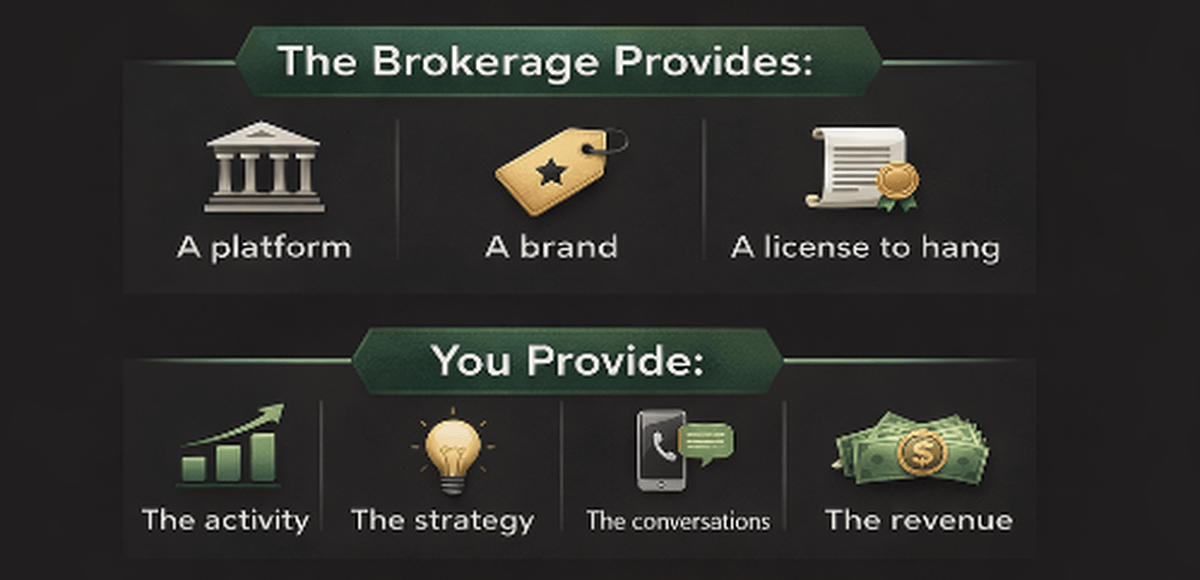
"I really hope that all realtors start realizing that they are the clients of the companies where they hang their license and not the other way around."– Andrea Gordon, Host of the Realizations Podcast
The business is yours.
I say this plainly on my podcast, and I'll say it here:
"Every single realtor, whether you know it or not, doesn't work for anyone. You work for yourself."– Andrea Gordon, Host of the Realizations Podcast
You, as a real estate agent, are an independent contractor by classification. You are self-employed.
The question isn't whether you're a real estate agent who’s self-employed - you are. The question is: Are you running your business like one?
"You are not an employee. You are an entrepreneur. How will you make that entrepreneurial success happen?"– Andrea Gordon, Host of the Realizations Podcast
To answer that question, let’s take a look at your mindset.
Do you have an entrepreneur mindset or an employee mindset?
The Mindset Gap: Where Most Agents Get Stuck
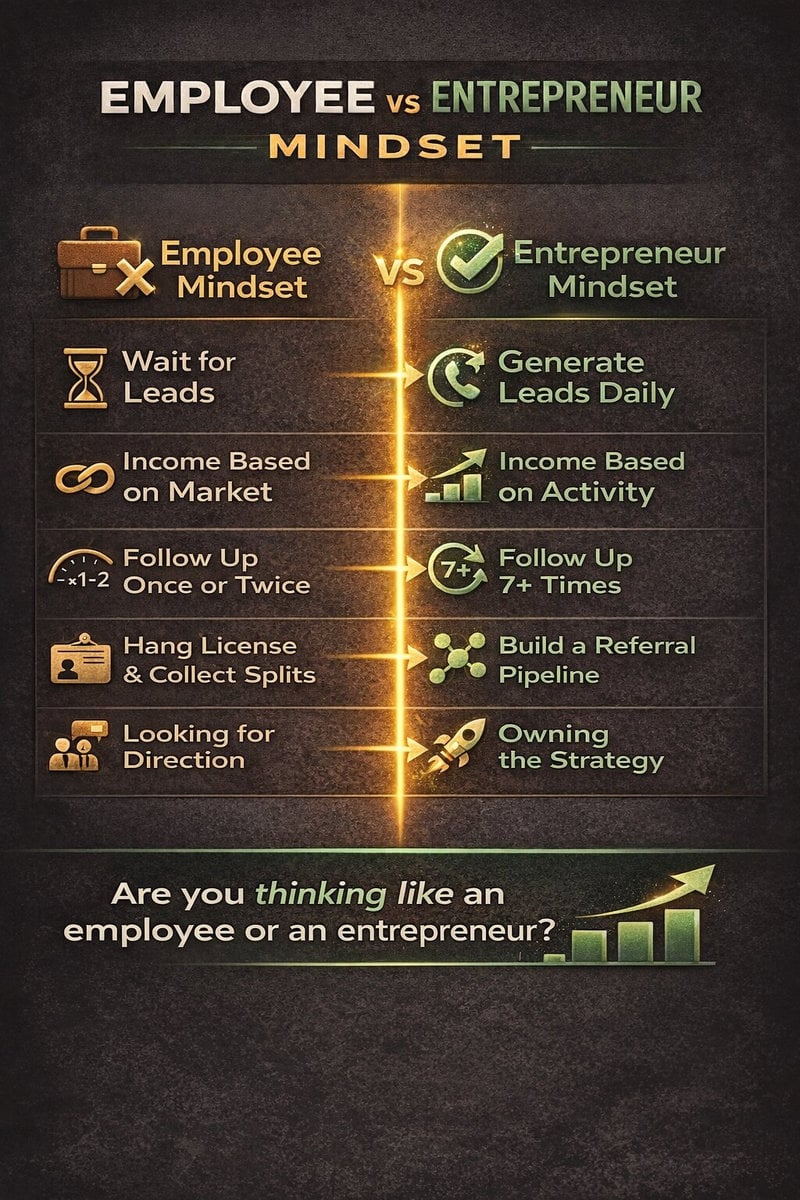
As Tony and I discussed in the podcast, when you have an employee mindset, you:
- Wait for the brokerage to provide leads
- Tie income to market conditions
- Follow up once or twice
- Just hang your license and collect splits
- Expectdirection from a manager
But when you have an entrepreneur mindset, you:
- Generating your own leads daily
- Income tied to your own activity
- Following up 7+ times consistently
- Building a database and referral pipeline
- Owning the outcome and the strategy
When I started my career, my first month in the business, I made six sales - and I've done that every year ever since. That didn't happen because someone handed me a pipeline. It happened because I treated my career as a business from day one.
The identity shift from employee to owner is where real estate entrepreneurship actually begins.
So what does operating like an owner actually look like in practice?
The Real Estate Agent Business Owner Model
The real estate agent business owner model comes down to one thing: you are the revenue center. Your brokerage provides infrastructure. You provide everything else.
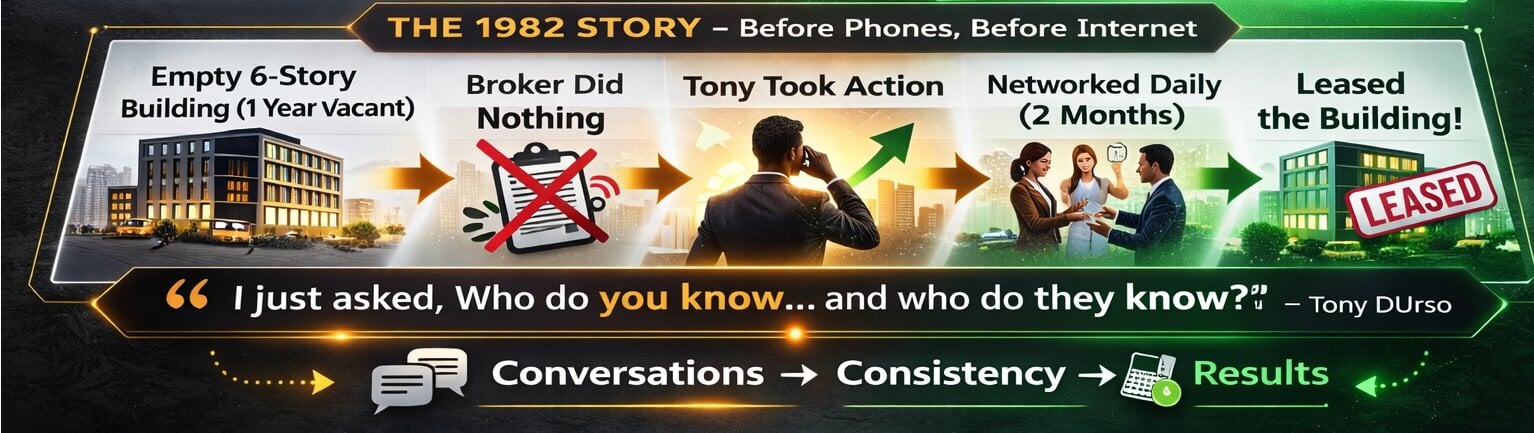
Tony DUrso illustrated this with a story from 1982, before cell phones, and before the internet.
He was sent by his company to troubleshoot a six-story commercial building in Toronto that had been sitting mostly empty for a year. The listing broker they’d hired to lease it had placed one or two tenants and done nothing else.
When the listing expired, Tony’s company chose not to renew it with that broker.
So Tony took it on himself.
- No broker.
- No listing agreement.
- Just him.
And he did something simple. He networked.
"So I networked. I just started asking, who do you know and who do you know? I'm not even joking."– Tony DUrso, Entrepreneur & Podcaster
He didn't have a sophisticated system. He didn't have technology. He had conversations, full-time, every day, for two months straight.
"I just went around spending all day, full-time talking to people and talking to people. In like two months, I filled up the whole building."– Tony DUrso, Entrepreneur & Podcaster
That Toronto story is a direct blueprint for how real estate agents should build their own business.
- You don't wait for your brokerage to generate leads.
- You go out and create them through consistent, genuine communication with people in your market.
Nobody is coming to fill your building for you.
And once you accept that, the next question becomes: how do you consistently create those conversations?
Follow Up Like Your Business Depends on It (Because It Does)
Stay in the follow-up business longer than most agents are willing to.
Most realtors give up on it too soon. Research from Invesp shows 44% give up after just one follow-up attempt. Because they're not treating follow-up as “communication.” They're treating it as a task to check off.
"The purest simplicity is communication."– Tony DUrso, Entrepreneur & Podcaster
In the podcast episode, Tony highlights the importance of having proper communication in your real estate business. Not email blasts. Not automated sequences. Real, two-way dialogue - with leads, with clients, with your sphere. And more of it than most agents are willing to do, because the bar is higher than most people realize.
"It takes at least seven interactions before any sort of real contact and communication happens with that lead."– Tony DUrso, Entrepreneur & Podcaster
Seven. Most agents stop at one or two, assume the lead isn't interested, and move on. Meanwhile, that lead eventually works with whoever stayed in the conversation long enough.
"Persistence is absolutely crucial when you're going to be an entrepreneur."– Tony DUrso, Entrepreneur & Podcaster
That's the entrepreneurial mindset in practice - not a strategy or a system, but a commitment to staying in it longer than the competition does.
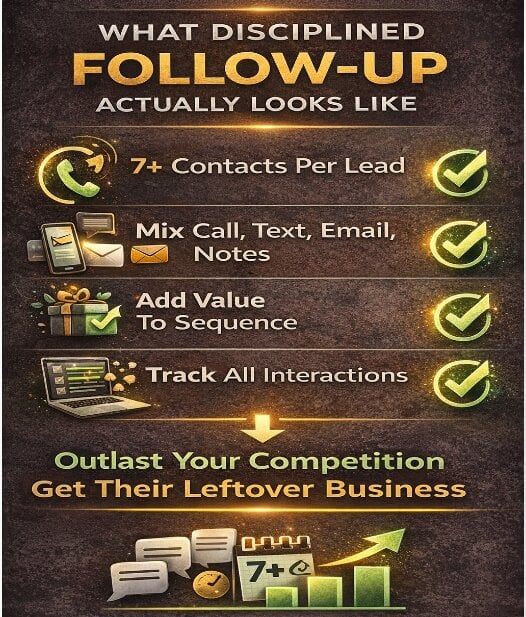
What Disciplined Follow-Up Actually Looks Like
- Follow up with new leads a minimum of seven times before pulling back
- Mix your touchpoints: calls, texts, emails, handwritten notes
- Create a follow-up sequence that adds value - not just check-ins
- Track every interaction so nothing slips through
When you stay in the conversation longer than your competition, you win their leftover business.
Real Estate Entrepreneurship Requires Persistence
In 11 years of podcasting, Tony DUrso has interviewed some of the world's most successful entrepreneurs across every industry imaginable.
And almost none of them had it easy.
"I think that I’ve only met one person in my career who had his or her life handed to them. Everybody else had to push. Everybody else had to work. Not one of them had it easy."– Tony DUrso, Entrepreneur & Podcaster
Real estate entrepreneurship is no different.
According to the 2024 NAR Member Profile, agents with 16 or more years of experience earned a median gross income of $92,500, with 46% of that group earning over $100,000. Agents with two years or less? A median of $8,100.
The agents who build sustainable, high-performing businesses aren't the ones who caught a lucky break in a hot market. They're the ones who kept going when the market shifted, when leads went cold, when deals fell through.
3 Traits Every Successful Entrepreneur Shares
- They never stopped.
- They never stopped
- They never stopped (again)
No one handed them success. Every person Tony interviewed, from the homeless-turned-millionaire to the Starbucks Frappuccino creator, had to grind for what they built.
When protocols changed, when clients disappeared, when markets crashed, they kept going. Stopping was never part of the plan.
Persistence isn't a one-time act, but the default setting of every successful entrepreneur he has ever interviewed.
"They never stopped. They never stopped. And furthermore, number three, they never stopped."– Tony DUrso, Entrepreneur & Podcaster
Personally, I've been through three economic downturns in my 28 years in this business. Each one shook the industry. Each one sent agents scrambling. The ones who made it through didn't have a secret formula, they stayed in motion.
Follow Passion, Not Just Commission
Tony gave advice that goes against what a lot of the big names in business coaching recommend.
Most of them say:
- Follow the money
- Pick the niche with the highest demand
- Build toward maximum revenue.
Tony says the opposite:
"You want to start a podcast? What do you like? Wrenching on cars? Knitting? Embroidery on shirt? You have to follow your passion."– Tony DUrso, Entrepreneur & Podcaster
If you’re passionate about luxury homes, then talk about luxury homes. Not because there's a waiting sponsor check. But because your passion will make you wake up every morning and do the work even when nobody's watching, and nothing is paying yet.
"You'll wake up every day to do that podcast because you like that topic."– Tony DUrso, Entrepreneur & Podcaster
This maps directly to real estate. I didn't become a top-producing agent by chasing whatever segment was hot. I came into this business through a deep belief that helping someone buy a home is one of the most genuinely meaningful things you can do for another person.
"Following your bliss… as Joseph Campbell said. you want to make sure that you are doing something which makes your one and only life meaningful."– Andrea Gordon, Host of the Realizations Podcast
Communication Is the Foundation of Real Estate Entrepreneurship
Everything in this article comes back to one thing. Tony said it directly, and I've seen it play out across 28 years in this business:
"Communication is always key in everything."– Tony DUrso, Entrepreneur & Podcaster
The kind of communication that actually moves the needle isn't a broadcast. It's not a mass email blast or a drip campaign. Tony was clear:
"The communication is both ways… this was interaction live and dialogue."– Tony DUrso, Entrepreneur & Podcaster
Real estate runs on real conversations. With buyers navigating life transitions. With sellers making one of the biggest financial decisions of their lives. With neighbors, vendors, referral partners. Tony raised $3.25 million in six months without a securities license and without knowing a single millionaire. Just by talking to people.
"I had no license, but I could talk."– Tony DUrso, Entrepreneur & Podcaster
|
The Real Estate Entrepreneur Formula
|
Real estate entrepreneurship doesn't require a perfect market, a big budget, or a lucky break. It requires you to show up, have real conversations, follow through longer than anyone else would, and genuinely care about the work you're doing.
Frequently Asked Questions
Are realtors entrepreneurs?
Yes. Real estate agents are independent contractors, not employees. They generate their own leads, build their own client base, and control their own income. Every realtor operates as a self-employed business owner, regardless of which brokerage they're affiliated with.
Is a real estate agent self-employed?
Yes. Real estate agents work as independent contractors. They are not on payroll. Their income is commission-based and determined entirely by the business they generate.
How do real estate agents build their own business?
Through consistent communication, active networking, disciplined follow-up, and relationship building over time. As Tony DUrso demonstrated by filling an entire building in two months, it doesn't require technology or a big budget - it requires showing up and having real conversations.
What is the real estate agent business owner model?
The brokerage provides infrastructure - licensing, compliance, brand, and support. The agent provides everything else: lead generation, client relationships, referral pipelines, and revenue. The agent is the business.
How do I think like an entrepreneur in real estate?
Start by owning the outcome. Treat your career as a business, not a job. Follow up longer than feels comfortable. Invest in your own development. Build systems for staying in contact with your sphere. Lead with passion for the work.
If you start podcasting like Tony DUrso, how can you monetize your podcast?
If you start podcasting like Tony DUrso, monetization typically begins with audience trust, not advertising. In the early stages, most podcasters earn through affiliate partnerships, product sales, coaching, consulting, or commissions tied to their expertise.
As audience size grows, sponsorship opportunities become viable. Podcasts with around 10,000 listeners can earn roughly $250 for a 60-second commercial spot, while larger established shows often secure annual contracts and premium brand partnerships.
Tony’s advice is simple: build from passion first. Establish authority. Serve your audience consistently. Monetization becomes a byproduct of value.
This podcast is produced by the Icons of Real Estate - #1 Real Estate Podcast Network
Apply to Be a Guest on the REalizations Podcast
If you serve the real estate industry through staffing, lending, brokerage, technology, or advisory, and help agents grow smarter, not harder…
Let's spotlight your insights.
Apply to be featured on the Realizations Podcast.