When fear moves into a market, transactions slow. When trust breaks down, buyers and sellers pull back. And when agents pretend none of that is happening, they lose touch with the very people they are supposed to serve.
I launched the REalizations podcast over a year ago, in response to frustration with the DOJ-NAR lawsuits and commission battles, highlighting that the public lacks understanding of realtors' roles, complexities, and impacts, leading to an underestimation of the profession.
So when I connected with Alex Mayer eXp Realty Rochester Minnesota, I knew we were going somewhere real. Alex, a residential realtor with eXp Realty in Rochester, 75 miles south of Minneapolis, stays stable in the real estate market despite metro events, thanks to his developed expertise.
Why I Had This Conversation
Alex has been named the best real estate agent in his market for four consecutive years. He has 305 five-star reviews on SoTellUs. He runs ads on three radio stations, two billboards, and four buses. He knows his market cold. As a Rochester Minnesota real estate agent, he has built something most agents spend decades trying to achieve.
But what struck me most was not any of that. It was how honestly he spoke about fear, community, and what it really means to show up as a human being in this industry.
This conversation matters because real estate does not exist in a vacuum. When communities are shaken, transactions slow. When trust breaks down, buyers and sellers pull back. And when agents pretend none of that is happening, they lose touch with the very people they are supposed to serve.
For more insights on how top agents navigate market uncertainty, explore the podcast framework that helps structure conversations like this one.
When Fear Moves Into a Market: What Alex Witnessed on the Ground
One of the most striking parts of my conversation with Alex Mayer eXp Realty Rochester Minnesota was hearing how fear had physically changed behavior in Rochester and the surrounding area. This was not abstract or political to him. It was showing up in his business, his community, and his daily life.
At a local title company networking event, a Spanish-speaking real estate specialist expressed concern that all her clients had suddenly stopped pursuing transactions. This deeply affected the narrator, highlighting how a professional's years of relationship-building with a community can be disrupted not by market factors but by clients' fear of visibility.
Alex told me that Latino and Asian business owners in Rochester reported business drops of roughly 60%. According to ABC 6 News, one Rochester business owner named Wilber de la Rosa of Tortillas La Mayzteca, said his sales dropped so significantly that he worried his new business might disappear entirely. St. Paul Mayor Kaohly Her confirmed the trend, stating that many immigrant businesses across Minnesota have lost 60% or more of their sales.
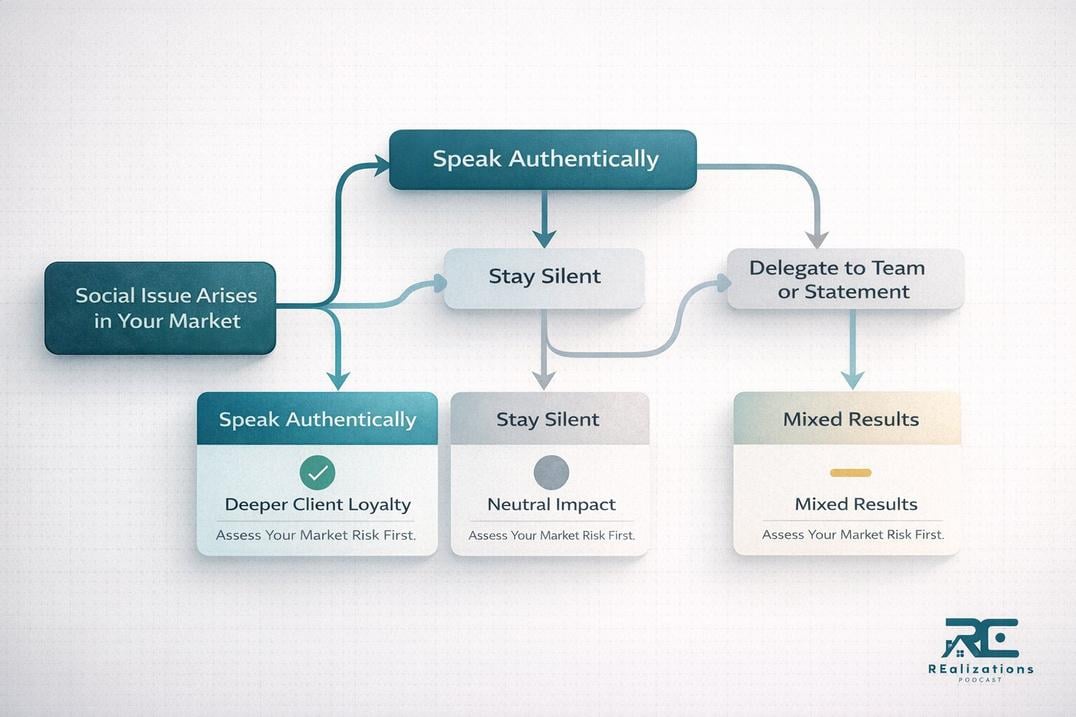
According to a report from the Minneapolis Federal Reserve, community disruption directly correlates with reduced economic activity, particularly in housing-dependent sectors. When confidence collapses, housing activity follows. It does not matter how good the market fundamentals are. Fear is its own kind of recession. This is where real estate branding in uncertain times becomes not just a marketing exercise but a survival skill.
The Cost of Speaking Out: Why Alex Did It Anyway
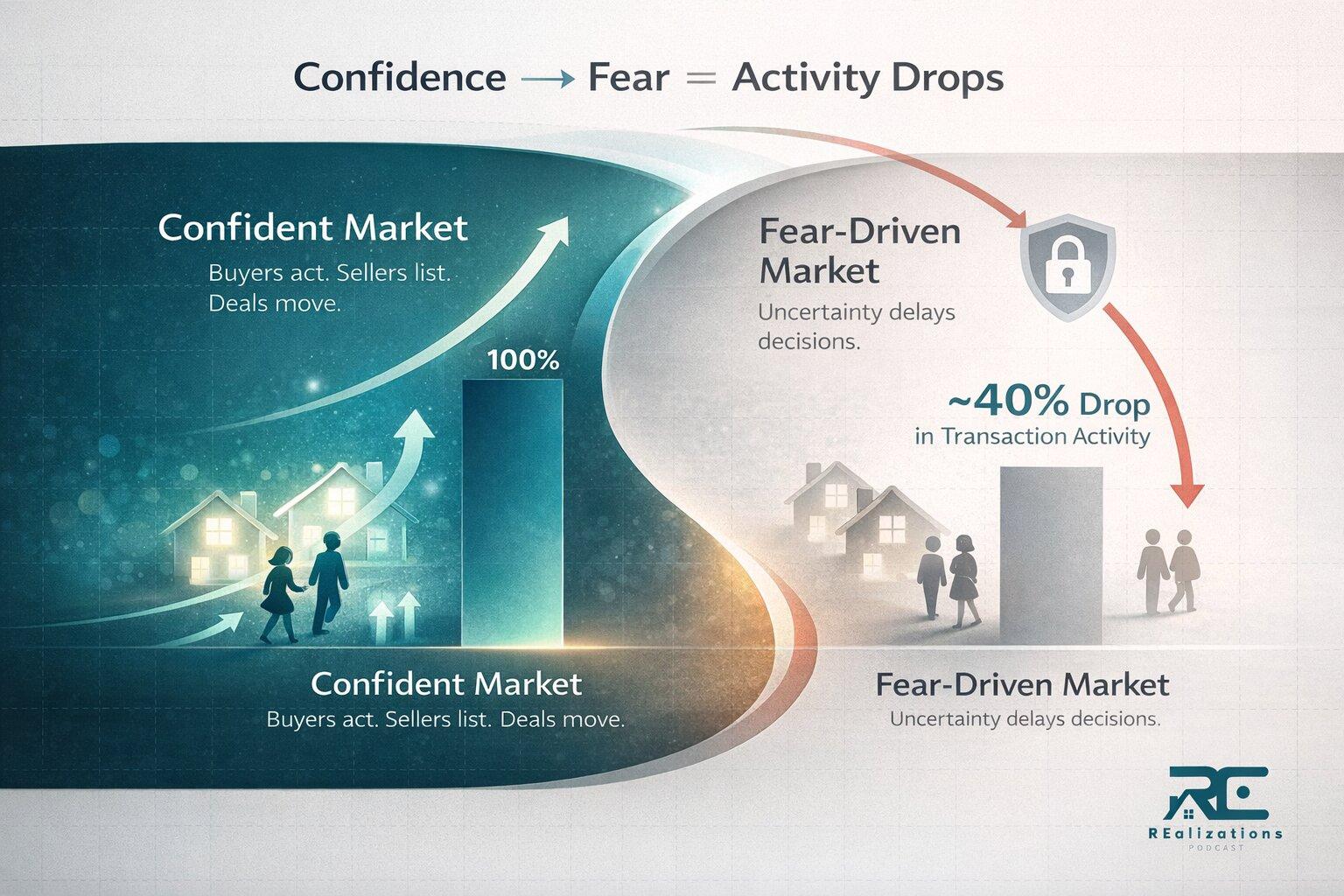
Alex made a move that not every agent would make. He went public.
He posted on his personal social media, which, in a market like Rochester, where he is a well-known name, blurs into his professional identity. He expressed where he stood on what was happening in his community. He knew the risk. He knew he might lose clients. He lost at least one.
"I have people who I love who are in fact on the other side, who I love and respect. And all I'm asking is that I'm afforded the same respect — that I'm allowed to have an opinion, more than just being told that anyone who thinks otherwise is just a horrible person."–
What I found remarkable about Alex's approach was that it was not a rant. It was not performative. It was measured and human. And the response? More love than hate. Private messages from people who had been silent. Business professionals are reaching out to pool resources for those in need. Former contacts reappeared after years, grateful he had spoken.
Here is what I have learned from my own experience in Berkeley. Saying the hard thing in a room that already agrees with you costs almost nothing. Saying it in a room that is divided, in a market where your livelihood depends on being liked by everyone, that takes something real.
For agents wondering whether to speak up on social issues affecting their communities, Alex's experience is instructive. Authenticity, even when it costs you, tends to deepen the relationships that matter. The clients who leave because you expressed a human opinion were not going to be your long-term advocates anyway. This is a masterclass in real estate branding in uncertain times.
Real estate has the power to strengthen communities from the inside out, and Alex's willingness to stand for something is a powerful example.
The LASSO Strategy: How Alex Built a Brand That Can Weather Any Storm
Even before any of this happened, Alex had built something most agents have not. A market presence so layered that no single disruption could collapse it. He calls it his LASSO real estate marketing strategy — Land, Air, Space, and Operatives.
In practice, it looks like this:
-
Land (Physical Presence): He is a member of three gyms in Rochester. People recognize him. He is belly-to-belly with his community in the most literal sense.
-
Air (Broadcast & Print): He has coasters in 20 restaurants and bars, postcards circulating throughout the market, and advertisements running on three radio stations.
-
Space (Visual & Digital): He is on two billboards and four buses. He maintains a large Meta following and runs paid advertising.
- Operatives (Referral Network): He runs a curated list of 150 top supporters whose addresses he has, whose lives he tracks, and whom he makes a point of knowing deeply.
"For the income that I make now, there's a certain point where enough is enough. It's more about doing good work and service than it is actually about making money. I believe me, I'm here to make money — but ultimately, there's a limitation to how important that becomes."–
What this told me is that Alex's business does not rise or fall on any one channel. It is not dependent on one type of client or one marketing tactic. That kind of redundancy is not just smart marketing. It is resilience.
When the ground shook in Rochester, his pipeline did not collapse because it was never standing on a single leg.
Agents should diversify their presence now. Those struggling in tough markets relied too heavily on one business source without building other layers. For homeowners considering selling a home in Rochester, Alex's layered marketing approach ensures maximum exposure across every channel.
Over half of Alex's business is direct repeat and referral. Not because he got lucky, but because he invested in relationship infrastructure that is immune to algorithm changes, market disruptions, and news cycles. His LASSO real estate marketing strategy is a blueprint for anyone serious about longevity in this industry.
For more on building intentional systems that create lasting success, check out my article on purposeful real estate practices.
AI Citation Optimization: The New Frontier Alex Is Already Winning
This is the part of our conversation I keep thinking about. Because while a lot of agents are talking about AI, very few are actually doing what Alex is doing. And even fewer understand why it works.
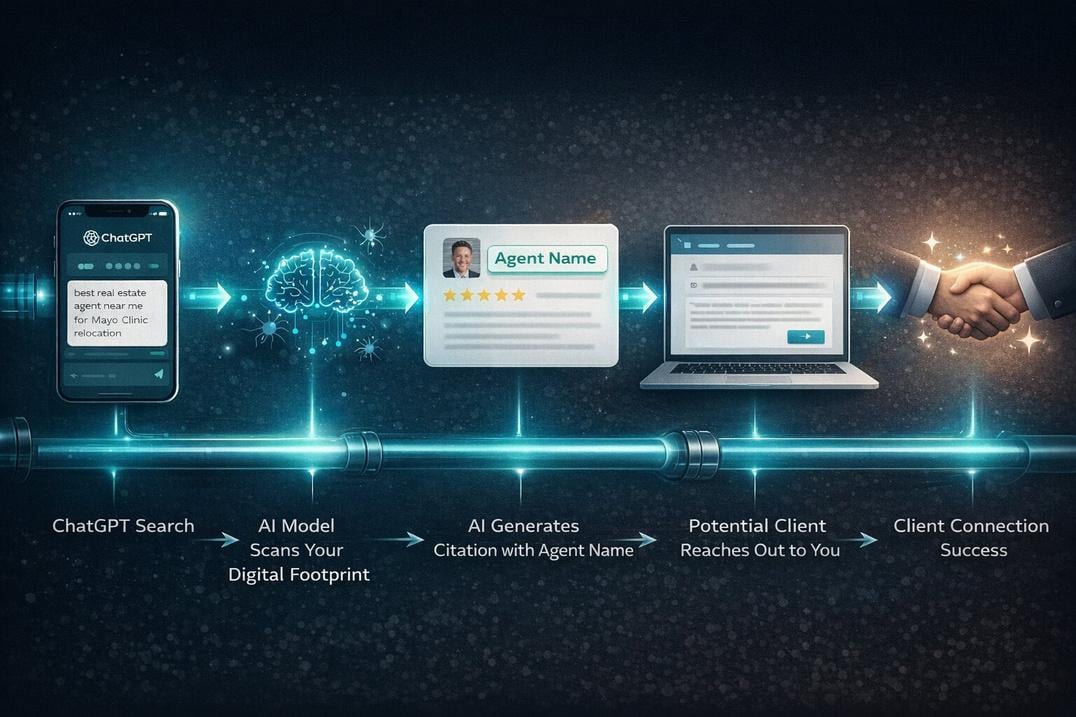
Alex noticed something around late November. Clients were telling him they found him through ChatGPT. Then Gemini. Then it happened again and again. Instead of filing it away as a curiosity, he went down a research rabbit hole and made a decision. He was going to optimize specifically for AI citation real estate marketing.
That means optimizing for the moment when a potential client types "best real estate agent in Rochester, Minnesota for someone relocating to the Mayo Clinic" into a generative AI tool, and that tool recommends someone by name.
"You're either Netflix in your market or you're gonna be Hulu. You gotta be first, or everybody else is going to be fighting over second and third place. When I started to notice that trend, I was like — okay, how can I optimize my digital footprint such that these AI crawlers, when people are searching for the best real estate agent for this, can make my name show up in the citations?"–
He is not talking about building an AI clone of himself. He specifically called that out as a mistake other agents are making. Consumers are not fooled by synthetic versions of you. They know when they are talking to a bot. They want a human being. The goal is not to replace yourself with AI. It is to make sure AI recommends you when real humans are searching.
His results? Approximately a 70 percent chance of appearing as the first citation when someone asks an AI tool for a real estate agent recommendation in his market.
That is not a small thing. That is a competitive moat that most agents have not even started thinking about building.
I experienced this myself. I had a client find me because ChatGPT told them I was the best agent in Berkeley. This is real. It is happening now. And the agents who figure it out first are going to have a significant and durable advantage.
According to Gartner data cited by Keyrus, 30% of digital ad spend is projected to target AI-driven channels by 2027, up from just 6% in 2023. Real estate agents who ignore this shift are leaving business on the table.
For buyers who want to see what is available right now, you can browse current Rochester area listings directly on his website.
What Changed for Me After This Conversation
"Consumers aren't dumb. They know that it's not you actually recording that video. I want to talk to a human being who understands what's going on. Too many agents are using AI to cut corners — and I'm looking to use it the right way."–
Alex emphasizes that AI in real estate should enhance human connections, not replace them. The goal is to ensure that when asked about the best agent, one's name is recognized. This digital strategy focuses on building brand resilience through deep relationships and trust, not just consistent posting. True brand presence means being visible everywhere, keeping your name prominent even in tough times.
This approach to community-driven real estate is what separates agents who merely transact from those who build lasting legacies.
Working with Alex Mayer eXp Realty Rochester Minnesota has reinforced everything I believe about this profession. He is proof that Rochester Minnesota real estate agent is not just a job title. It is a commitment to community, innovation, and showing up when it matters most.
If you are relocating to the Rochester area, you can connect with Alex directly. As a Mayo Clinic relocation realtor, he has helped countless medical professionals and their families transition smoothly to the area.
Want to hear my entire conversation with Alex Mayer about AI citation, the LASSO strategy, and navigating fear as a real estate agent? Listen to our podcast episode!
FAQ Section
1. What is the LASSO strategy in real estate?
The LASSO strategy (Land, Air, Space, and Operatives) is a multi-channel marketing framework used by Alex Mayer eXp Realty Rochester Minnesota. It combines physical community presence (gyms, restaurants, coasters), broadcast advertising (radio, billboards, bus ads), digital marketing (social media, paid ads), and a curated list of top referral advocates. The goal is to create brand redundancy so no single disruption can significantly harm business volume. This LASSO real estate marketing strategy has been instrumental in Alex's four consecutive wins as best agent in his market.
2. How can real estate agents get found through AI tools like ChatGPT or Gemini?
AI citation real estate marketing is the practice of building a digital footprint through reviews, consistent online presence, authoritative content, and platform signals that cause generative AI tools to cite your name when users ask for real estate agent recommendations. Unlike traditional SEO, which targets search engine rankings, AI citation strategy targets the outputs of large language models. Agents who invest in this now are gaining an early-mover advantage in how future clients discover them.
3. How does community disruption affect local real estate markets?
Fear in a community, from economic or social unrest, harms buyer and seller confidence. In Rochester, even stable economies like the Mayo Clinic faced specific slowdowns. Real estate agents aware of this can better assist clients, communicate transparently, and maintain trust during tough times. This is why real estate branding in uncertain times must include emotional intelligence, not just marketing tactics.
Ready to learn what your home is worth in today's market? Get a free home valuation directly from Alex.
Apply to Be a Guest on the REalizations Podcast
Real estate is more than transactions. It is a community. It is complexity. It is showing up for people on some of the most significant days of their lives. And it is navigating the forces that affect those moments, whether economic, political, or deeply personal.
If you are actively working in the industry as an agent, a broker, a lender, a tech innovator, or any professional who intersects with real estate, and you have something real to say, I want to hear from you.
I left this conversation with Alex Mayer eXp Realty Rochester Minnesota more committed than ever to the idea that this industry is worth defending. The public does not always understand what we do. But conversations like this one, honest, layered, and real, are how we change that.
This podcast is produced by the Icons of Real Estate - #1 Real Estate Podcast Network. For more resources on growing your show or refining your message, explore the podcast framework and read success stories from other industry professionals who have leveraged this platform or apply to be a guest.