
Starting a real estate career requires far more than passing a licensing exam or having strong people skills. The reality is that success depends on managing delayed income, navigating uncertainty, understanding commissions, and building a consistent pipeline from day one.
Here’s a quick preview of this episode: [youtube shorts here]
When I spoke with Vera Claeys, an event production professional exploring a transition into the industry, her questions reflected what many aspiring agents are trying to figure out.
My conversation with Vera about her real estate career highlights exactly what new agents need to understand before making the leap.
My Conversation with Vera Claeys: Starting From Scratch
Vera came to me with a background in event production and commercial work. She had planned festivals, managed high-pressure logistics for photo shoots with brands like Wayfair and U.S. Bank, and served as an executive assistant at UC Berkeley's School of Education. Then in April, she lost her job.
For the first time since age 17, Vera wasn't working. The mental health hit was real. Instead of panic applying to the next role, she took the summer to ground herself. She worked as a production assistant, drove box trucks, set up crafty tables, and gave herself space to breathe.
A friend who owns a bar gave her unexpected advice. He said most people who think real estate is easy fail. The fact that Vera had never considered it meant she might actually succeed.
That conversation brought her to me. You can learn more about Vera on her website, follow her journey on Instagram, or connect on LinkedIn.
The Reality of Starting a Real Estate Career
Most people underestimate how hard this business is. They hear stories of big commissions and assume the money comes easy. Nothing could be further from the truth.
According to the National Association of Realtors, nearly 70 percent of agents did not close a single deal in 2024. The myth of easy money collapses fast when you face the actual numbers.
What new agents don't expect is the complete absence of structure. No salary. No guaranteed income. No one is telling you what to do each day. You wake up with zero dollars in the pipeline and have to fill it yourself.
I have seen too many talented people wash out because they thought real estate would be a part-time gig with full-time pay. It does not work that way. Building a sustainable real estate business requires treating it like a serious entrepreneurial venture from day one.
"There's no instant gratification in how you get paid. You close four deals in January, but if you take your foot off the gas for a month, February will have no closings. You are only as good as how many things you have going on that pull you into the future. That's the reality of the money."–
Vera heard this and nodded. She wasn't looking for easy or instant gratification. She wanted something that would let her use her skills fully. Her previous roles left her unfulfilled. Real estate, she realized, might be the challenge she needed.
How Real Estate Commissions Actually Work
For a clear breakdown of real estate commissions explained, let me walk you through a real example. Say you have a $20,000 gross commission. Sounds like a lot, right? Here is what actually happens to that money.
Commission Breakdown Example
|
Stage |
Amount Remaining |
|
Gross Commission |
$20,000 |
|
After 6% Brokerage Fee |
$18,800 |
|
After Agent Split (60-70%) |
~$12,000 |
|
After E&O Insurance, Dues, Fees |
~$10,000 |
|
After Taxes (Independent Contractor) |
~$7,000 |
Most brokerages take 6 percent off the top automatically. Then your split as a new agent typically runs 60 to 70 percent, meaning another 30 to 40 percent comes off. Errors and omissions insurance runs $2,000 to $3,000 per year. Real estate dues add another $2,000 minimum. I belong to three associations, so mine hit $6,000.
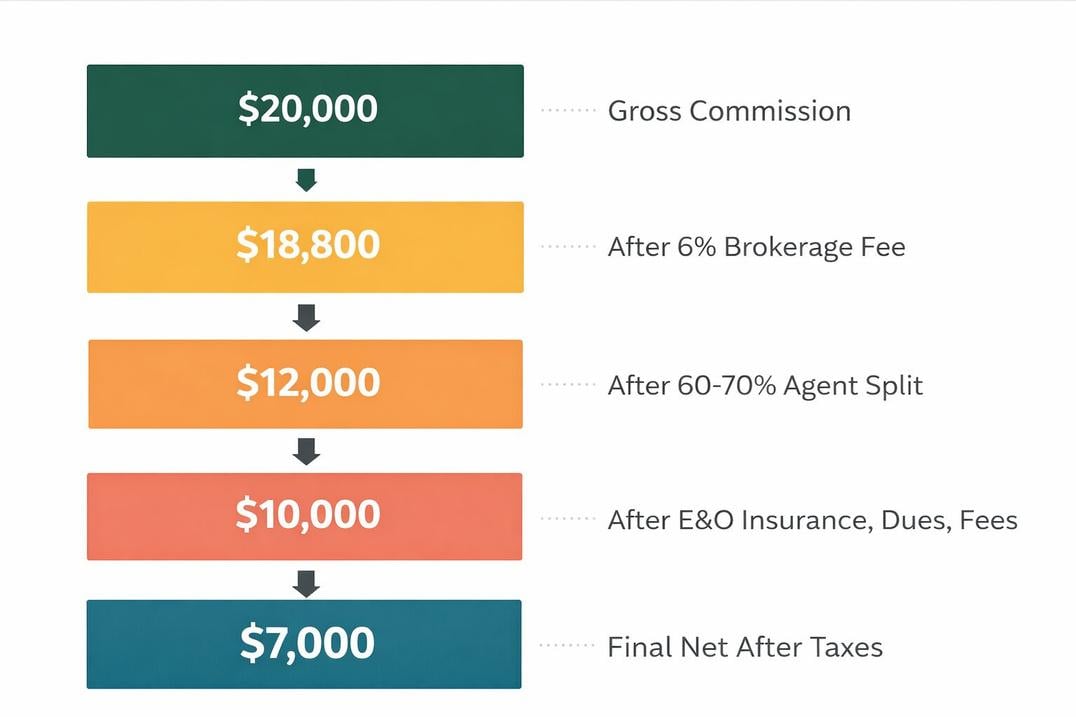
Then come the taxes. Independent contractors get taxed mercilessly. You deduct business expenses where you can, but that $20,000 commission ends up around $7,000 in your pocket.
For more detailed guidance on launching your career, check out this podcast framework that breaks down how successful agents build their businesses.
The Grind Behind Success: Why Grit Matters More Than Talent
Vera asked me what she should do first. My answer surprised her. I told her to get her license and then just go for it. No dusting books. No fetching coffee. You are there to sell real estate.
Here is what the daily grind actually looks like:
-
No salary or guaranteed income whatsoever
-
Deals take 30 to 45 days to close from contract to cash
-
Clients can take months or even years to convert
-
Consistency beats bursts of effort every single time
This is the reality of a Vera Claeys real estate career once the license is in hand.
I gave Vera an example from my own career. I worked with a couple for two years. Two years of 8 a.m. Sunday calls wanting to see something at 9 a.m. Two years of last-minute cancellations and imperious demands. I showed them 37 properties.
The week they finally found something they liked, I had the flu. 102-degree fever. I sent my assistant to show the property. When I called to review disclosures before offers were due, they fired me. One day before offers were due. After two years.
That is an extreme example, but it teaches a crucial lesson. Trust your gut. The second I met those people on Zoom, I knew they weren't my people. But I saw dollar signs and ignored my instinct. Never again.
The U.S. Bureau of Labor Statistics notes that real estate agent turnover remains high, with many leaving within the first five years. The ones who stay develop systems and emotional resilience. Purposeful real estate practices around decision management and daily protocols separate the agents who last from the ones who burn out.
The Emotional Side of Real Estate: Clients, Stress, and Rejection
Difficult clients are part of the job. Long sales cycles wear you down. Deals fall apart for reasons completely outside your control.
Learning to detach emotionally is a survival skill. I recommend reading The Four Agreements to every new agent I meet. The book teaches you to remember that other people's behavior is their stuff, not yours. Be impeccable with your word. Treat people kindly. Move with grace through the world.
Vera and I connected deeply over this. She is 34, recently divorced after nearly ten years of marriage. I told her I married at 19 and divorced at 25. I did not remarry until 46. Nobody should do anything drastically major before age 30. You change so much in your twenties.
That same patience applies to real estate. You will not have it figured out in year one. You will make mistakes. You will get rejected. You will cry in your car. Then you will get up and do it again.
Real Estate Risks and Lawsuits: Why Details Matter
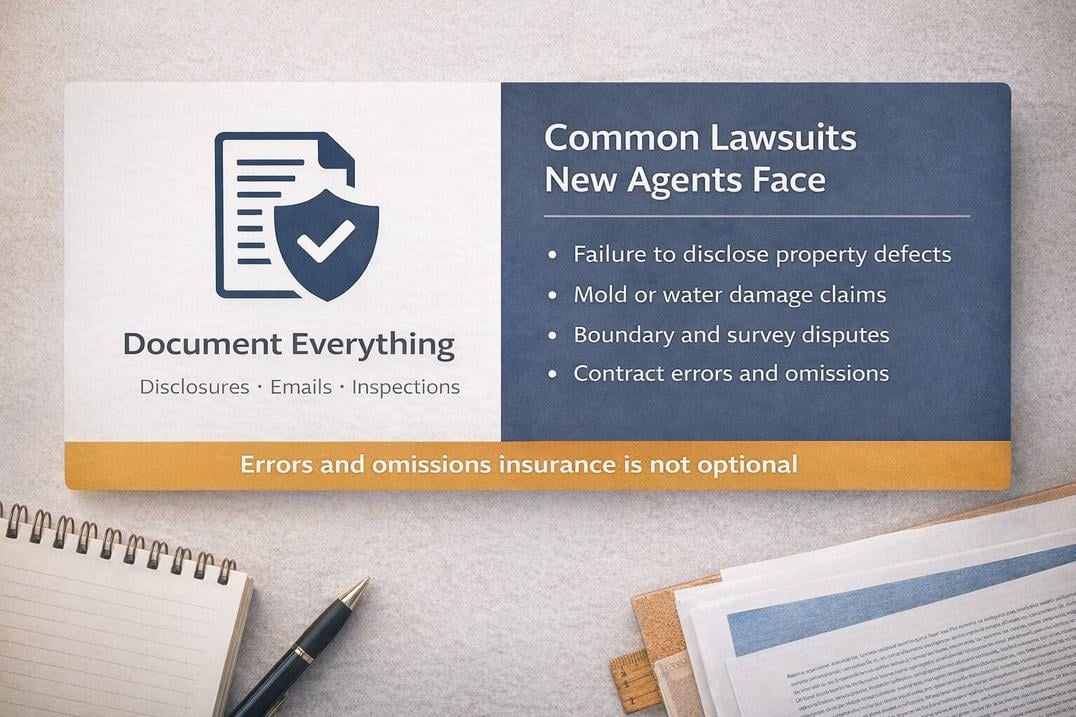
Understanding real estate risks and lawsuits is not optional for new agents. The rise of litigation in real estate is real. Millennials, as a generation, are more litigious than any before them. Combine that with buyers who overpaid in 2021 and now sit on properties worth $200,000 less than they paid, and you have a lawsuit cocktail.
Documentation saves careers. Disclosures must be thorough. Never gloss over problems.
"You will probably do nothing wrong and still end up in a lawsuit at some point. I've done over a thousand transactions and had five lawsuits. That's nothing statistically. But when it happens, remember it's not you, it's somebody else's stuff. Be impeccable with your word, treat people kindly, and move with grace. Don't get mired in negativity because it can subsume you."–
I have been sued for mold inside a wall that my 87-year-old sellers did not know existed. I did nothing wrong. Failed to disclose anything. But the buyers sued the sellers, and the sellers sued my brokerage because they knew the company had deep pockets and large insurance policies.
If you get your broker's license, you are held to a higher standard of knowledge. Work through a major brokerage that has a broker of record and a retinue of attorneys. They protect you. Going out on your own without massive funds behind you is a dumb idea.
For real estate professionals looking to share their experiences, this podcast network offers a platform to reach industry peers.
The First Steps to How to Become a Real Estate Agent
If you are wondering how to become a real estate agent, start with licensing. Most people take classes online. You can do that. But I strongly recommend taking an in-person class at a junior college or community college instead.
Why? Because the classroom experience gives you things that online courses cannot match:
-
The teacher is usually a jaded old realtor who has been in the trenches and is now out of the business
-
The class has 40 or 50 hardworking people with families who are considering a career change, so you learn from their questions and stories
-
You role-play scenarios with real people, not a computer screen
-
The material cements differently over a semester or quarter, not one week crammed into a test
When I sat for my license exam, I was prepared.
A warning about your broker's license:
-
Do not get your broker's license as a new agent. I never have. The reason is liability.
-
When you have a broker's license and go out on your own, all legal exposure crashes down on you
-
A lawsuit asking for $1.7 million could leave you personally responsible for $250,000 if you cut corners on insurance
-
Working through a major brokerage with a broker of record and attorneys protects you
Check the California real estate license requirements before you start. The process is straightforward but has specific steps you cannot skip.
Learn more about podcast production if you are interested in sharing your real estate journey with a wider audience.
Should You Join a Team or Go Solo?
Join a team. That is my advice for every new agent.
Being on a team gives you a family of people to learn from. Team leaders provide leads. They ask you to do things, which teaches you how. You make whatever percentage you negotiate.
I pay my assistants 20 percent of every deal they work on. When they bring their own buyer deals, I take a 35 percent referral. Most team leaders operate at a 90 percent split with their brokerage, so the hit to you is manageable.
Most people filter through teams in two to three years. Then they decide whether to stay, start their own team, or go solo. That timeline gives you enough experience to make an informed choice. Some agents eventually thrive, building a business around community relationships independently, but that comes after years of learning the ropes on a team.
The First 90 Days: New Real Estate Agent Tips That Work
Vera asked me exactly what she should do in her first 90 days. Here is the playbook I gave her:
-
Contact everyone in your database. Tell them exactly what you are doing. Ask directly for business. Say you will do whatever it takes to succeed, and you would be so grateful for their help.
-
Hold as many open houses as you possibly can. Talk to every person who walks through the door. Find out who does not have an agent and sell yourself to them.
-
Practice scripts and conversations constantly. Role-play with anyone who will help you. Learn to guide clients gently without pushing them.
-
Stay consistent every single day. Lead generation never stops. The moment you take your foot off the gas, your pipeline empties.
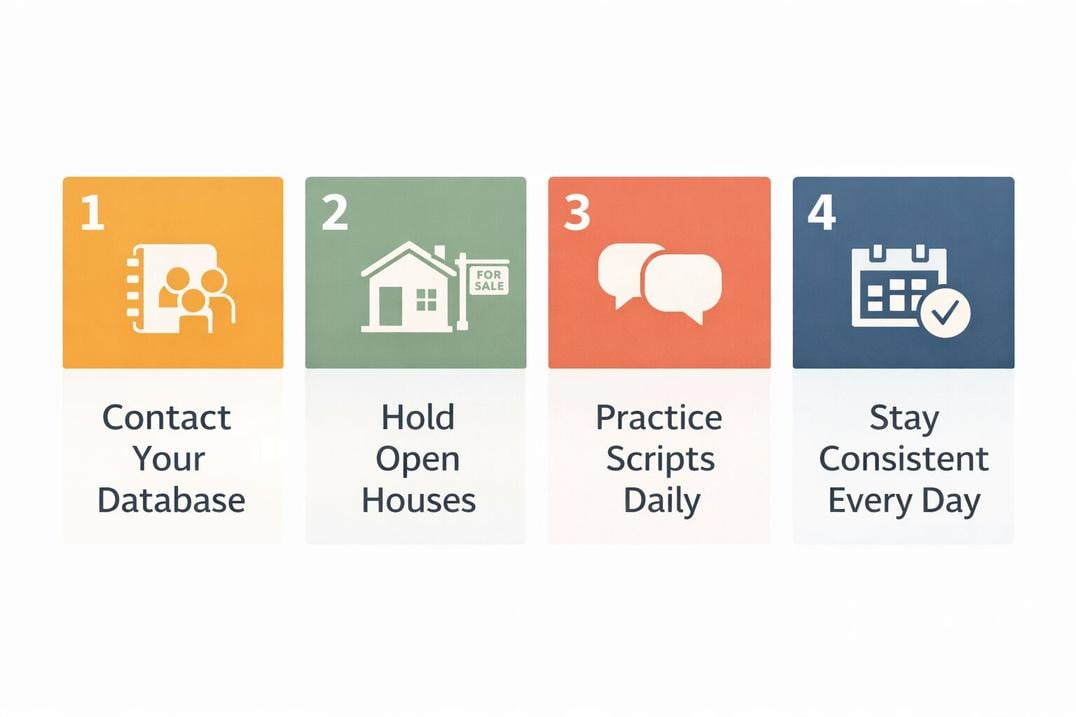
These new real estate agent tips have helped countless beginners survive their first year. Vera has a large database from her years in events and production. She left her previous roles on good terms. She is in a great position to make those calls.
Lead Generation: What Works and What Does Not
Do not buy Zillow leads. I used to spend $90,000 a year on them. I made about $90,000 back. It was a break-even proposition with massive administration headaches and a terrible taste in my mouth.
Building a Vera Claeys real estate career requires smarter strategies than buying overpriced leads.
Zillow was started by the same people who created Expedia. Expedia's stated goal was to remove the middleman, the travel agent. Zillow's ultimate goal is to get rid of realtors entirely. Redfin is the same. They pay agents as employees, but those agents make about 30 percent of what a traditional realtor earns. Never involve yourself with Redfin.
Instead, build organic relationships. Your sphere of influence is your goldmine. Open houses bring you face-to-face with active buyers. Referrals come from past clients who trust you.
Lead Generation Funnel
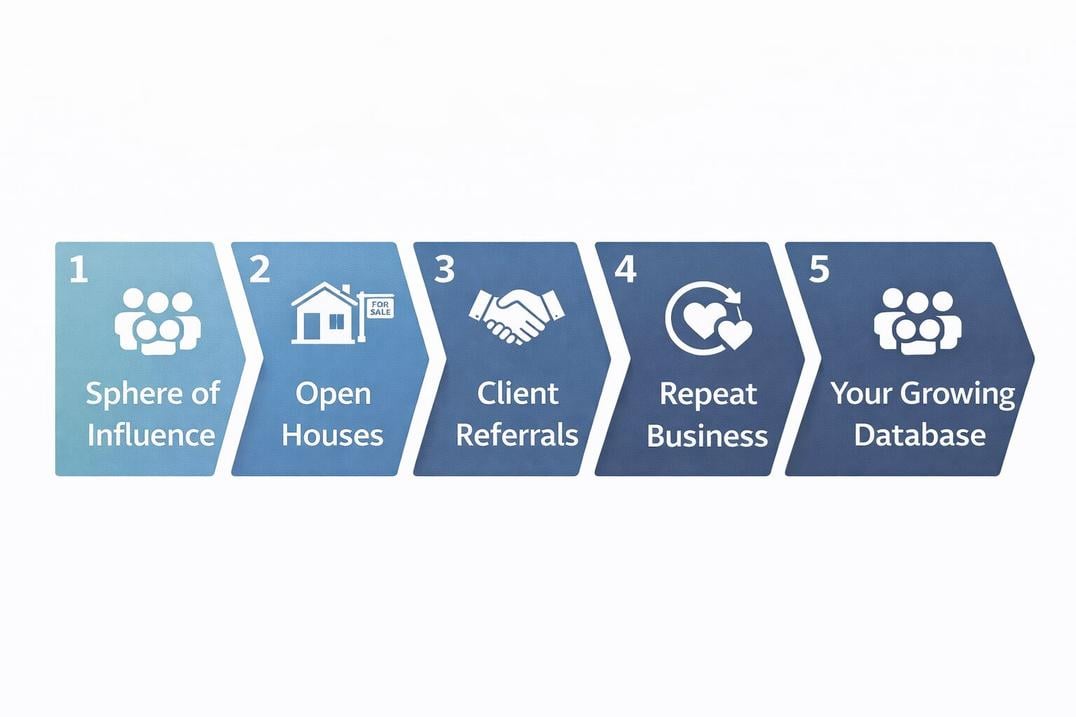
Sphere of Influence → Open Houses → Client Referrals → Repeat Business → Your growing database
Get involved with a charity or organization you genuinely champion. I support theater and the Berkeley Humane Society. I have had people call me to list their houses simply because they know how much I love animals. That kind of authentic connection cannot be bought. Service-driven real estate builds long-term success in ways paid leads never will.
Safety in Real Estate: What New Agents Must Know
Personal safety is not discussed enough in real estate training. I have friends who have been beaten up, locked themselves in bathrooms without their cell phones, and waited desperately for help. Others have been robbed.
Never park in a driveway. Always park parallel on the street so you can leave quickly. If you park in a driveway, someone can t-bone you and block you in. Criminals assume realtors have money.
Do not hold an open house alone in a neighborhood where you feel unsafe. Bring another person. Do not sell in areas where you would not feel comfortable walking to your car at 10 p.m.
Now, buyer broker agreements are required before you show anyone anything. That actually helps with safety. You meet people at the office first. You have paperwork. You are not picking up random strangers.
But stay vigilant. If something feels wrong, walk away.
"I always suggest that people take improv classes to be real estate agents. You need to be able to think on your feet with the crap that comes up. The stuff that can come up in real estate is unbelievable. You would be shocked."–
The Skills That Separate Successful Agents
Communication tops the list. You must be able to explain complex transactions in plain language. Adaptability follows close behind. Every deal brings surprises.
Improv and roleplay skills matter more than most people realize. I tell new agents to take improv classes. You need to think on your feet when clients throw curveballs. The crap that comes up in real estate is unbelievable.
Reading people and situations is the third essential skill. Learn to distinguish between a serious buyer and a tire kicker. Recognize when a client is talking themselves out of a good decision. Know when to walk away from a bad fit.
Vera loved this advice. She had not taken improv since early college, but she immediately saw the value in refreshing those skills. Her theater background in Austin, where she worked at Zach Theater for eight seasons, gives her a head start.
Key Takeaways for Anyone Considering Real Estate
Real estate is not easy. But it is worth it for the right person. The freedom, the income potential, and the ability to help people with one of the biggest decisions of their lives make the hard days bearable.
Systems and discipline win. The agents who succeed are not the smartest or the most talented. They are the ones who show up every single day, make the calls, hold the open houses, and follow up when they would rather do anything else.
Relationships drive success. Your database, your past clients, your sphere of influence, and your community connections are your greatest assets. Nurture them. Read CFPB home buying guides to understand what your clients are learning on their own.
Long-term thinking is critical. You will not make money in your first month. You may not make money in your first six months. But if you build your pipeline consistently, the closings will come.
Starting a Vera Claeys real estate career means embracing all of this. The grind, the rejection, the lawsuits, the safety concerns, and the delayed paychecks. It also means the freedom, the relationships, and the deep satisfaction of guiding someone home.
Listen to my full conversation with Vera on the REalizations Podcast, where we talk about commission realities, lawsuit risks, and what it really takes to survive year one.
FAQ Section
Is real estate a good career for beginners?
Yes, but only if you are prepared for inconsistent income, long hours, and a steep learning curve. Most new agents underestimate how hard the first two years will be. If you have savings to live on and the grit to keep going after rejection, real estate can be a great fit.
How long does it take to make money in real estate?
Most agents take several months to close their first deal. From the day you get your license, expect 90 to 120 days minimum before you see a commission check. Building a consistent income takes two to three years. Some agents close a deal in their first month. That is the exception, not the rule.
Do I need to join a team as a new agent?
It is highly recommended. A team provides mentorship, leads, training, and emotional support. You learn faster and make fewer expensive mistakes. After two or three years, you can decide whether to stay, start your own team, or go solo. Most successful agents started on someone else's team.
Apply to Be a Guest on the REalizations Podcast
Real estate is evolving. Capital is shifting. Markets are tightening. If you are actively working in the industry and solving real problems, whether in construction, finance, brokerage, or development, I would love to hear from you.
This podcast is produced by the Icons of Real Estate - #1 Real Estate Podcast Network. For more resources on growing your show or refining your message, explore the podcast framework and read success stories from other industry professionals who have leveraged this platform, or apply to be a guest across the network.