
After 28 years and over a thousand transactions in the Bay Area, I've watched agents burn out chasing the wrong clients, fight sellers on pricing they should have seen coming, and wonder why their pipeline is full but their bank account isn't.
Almost every time, the root cause is the same: they skipped qualifying real estate leads the right way.
Not the budget-and-timeline checklist. The real thing: alignment, psychology, and knowing when to walk away before you waste weeks of unpaid labor.
I sat down with DJ Paris on the Keeping It Real podcast to get into all of it. We unpacked:
-
How I identify the right clients,
-
How to walk away from the wrong ones, and
-
Why the agents who convert the most leads are the ones who listen between the lines - not the ones with the slickest scripts.
Check out the full conversation from my talk with DJ Paris:
Why Most Agents Qualify Leads Incorrectly
The uncomfortable truth is that most real estate agents are terrible at qualifying leads because they're terrified of saying no.
They accept every inquiry, chase every lead, and then wonder why they're burned out, underpaid, and stuck with clients who make their lives miserable.
Typical Qualification Process
|
How Most Agents Qualify |
What It Actually Is |
|
"What's your budget?" |
Screening for money, not fit |
|
"When do you want to move?" |
Screening for urgency, not readiness |
That's not qualifying. That's a recipe for wasted time, poor conversion rates, and a reputation that attracts more of the wrong people.
"I think that's a big problem with realtors in general is that we're a lot of people pleasers and we're extremely concerned what people think of us. And the reality is that people think of themselves - they pretty much don't think of you unless you actually affect them in some way." - Andrea Gordon, Realtor and Host of Realizations Podcast
Result of People Pleasing Through Every Inquiry
When you say yes to every lead without filtering for fit and readiness, it can be both frustrating and costly.
In real estate, only about 1 in every 100 leads turns into a closed transaction, meaning the industry’s average lead-to-client conversion rate sits around 0.4%–1.2%. That means 98–99 out of 100 “interested” contacts never become a deal.
So when you treat every inquiry like a hot opportunity, the result is:
-
Burnout from clients who were never going to close
-
Difficult transactions that drain your time and energy
-
A pipeline full of misaligned leads — and no filter to stop more from coming in
Understanding what a real qualification looks like is the first step to fixing that.
The Real Meaning of Qualifying Real Estate Leads
True qualification goes far deeper than financial readiness. I approach it as a multi-dimensional assessment that includes the following:
|
Dimension |
The Real Question I'm Asking |
|
Motivation Clarity |
Do they have a real reason to move, or are they just browsing? |
|
Emotional Readiness |
Are they psychologically prepared for what this process actually involves? |
|
Decision-Making Ability |
Can they commit, or will they look at 200 houses and still be unsure? |
|
Trust Receptiveness |
Will they take professional guidance — or second-guess everything? |
|
Communication Style |
Do they respond? Do they show up? Do they communicate honestly? |
Most agents only ever check budget and timeline. These five dimensions are what separate a smooth transaction from a nightmare — and once you know what you're looking for, the next step is figuring out exactly who your ideal client is.
"There are subtleties in people's ways of communication, that people don't kind of key into when they're talking to somebody. You need to listen to what's between the lines. You need to figure out what the subtext of what they're saying actually is." - Andrea Gordon, Realtor and Host of Realizations Podcast
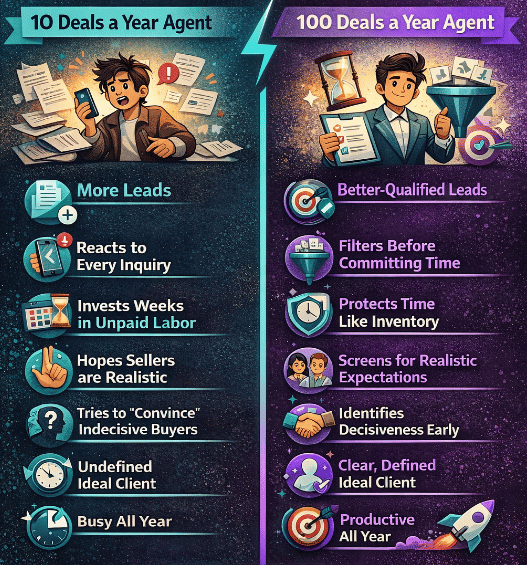
Agents Who Close 10 Deals VS 100 Deals: What’s The Difference?
This is the difference between agents who close 10 deals a year and agents who close 100.
The high-volume producers aren't working more leads, they're working better-qualified leads. They've learned to detect the following buyers before investing weeks of unpaid labor.
-
✘ Unrealistic sellers
-
✘ Indecisive buyers, and
-
✘ "Professional victims"
Knowing what you're actually looking for is the foundation of the whole framework - and it starts with identifying who your ideal client really is.
How to Identify Your Ideal Real Estate Client
My framework for how to identify your ideal real estate client is deceptively simple — and wildly effective. It starts with one honest question: who are you?
The Venn Diagram Niche Strategy
I use a Venn diagram niche strategy where you map your own personality traits, values, interests, and communication preferences. Then find the overlap with the types of clients who share them. That intersection is your best fit client real estate.
"It can be as simple as taking a big sheet of yellow lined paper and putting your own likes and dislikes on either side. I also put together a Venn diagram... where you intersect with a variety of different things is your best fit customer. Be perfectly, ridiculously, relentlessly honest about it." - Andrea Gordon, Realtor and Host of Realizations Podcast
My own answer? A highly educated hippie who's wealthy. And I'm fortunate to live in Berkeley, where that describes half the population. The principle works anywhere. Here's how different personality types map to their best-fit clients:
|
Your Personality Type |
Your Best Fit Client |
|
Analytical / Engineer-type |
Detail-oriented, data-driven buyers |
|
Creative / Storyteller |
Clients who value vision over spreadsheets |
|
Direct / No-nonsense |
Decisive clients who hate being over-explained to |
|
Warm / Relationship-driven |
Clients buying through major life transitions |
Why This Exercise Actually Affects Your Income
This isn't just a feel-good exercise. Getting clear on your ideal client directly impacts three things that determine what you earn:
-
Lead filtering → you stop wasting time on people who were never going to be a good fit
-
Marketing clarity → your real estate niche marketing strategy sharpens, so the right people find you instead of the wrong ones
-
Conversion efficiency → aligned clients trust you faster, which means fewer objections and shorter sales cycles
And once you know who you're looking for, the next skill is learning to truly hear them.
Listening as a Lead Qualification Tool
Real estate agent listening skills are one of my core competitive advantages.
Studies show most people only retain 25–50% of what they hear. That means if you're already thinking about what to say next while a client is talking, you're missing half of what they're actually telling you. This includes the signals that tell you on whether they're worth taking on at all.
Most agents lose that intel without even realizing it. Not me. I read the subtexts.
"If you're actually hearing someone's goals, aspirations, dreams, desires... listening for how they speak, how their physical being is while they're saying those things... People reveal themselves by the language that they pick to use. People reveal themselves by the emphasis that they place on words. People reveal themselves by the ways in which they don't respond to things." - Andrea Gordon, Realtor and Host of Realizations Podcast
Where Real Estate Client Psychology Becomes a Practical Skill

This is where theater training meets real estate mastery, and where real estate client psychology stops being abstract and becomes something you use in every single conversation. I read body language, word choice, emphasis, and silence the way an actor reads a script, always looking for what's underneath the surface:
-
Crossed arms and vague answers → That's resistance
-
Leaning in and mirroring your posture → That's trust forming
-
A seller who keeps saying "I just need to get X amount" without engaging with market data → that's a client who will reject your guidance at the worst possible moment
Client Communication Red Flags vs. Green Flags
|
🚩 Red Flags |
✅ Green Flags |
|
Vague about motivation to move |
Clear life event driving the decision |
|
Dismisses market data or comps |
Asks questions and engages with numbers |
|
Crossed arms, avoids eye contact |
Leans in, mirrors your body language |
|
Has seen 50+ homes with other agents |
Focused criteria, open to guidance |
|
Blames previous agents for everything |
Takes ownership of past decisions |
|
Won't commit to a showing schedule |
Responsive, communicates proactively |
When to Walk Away From a Lead
This is where most agents choke. Walking away from a potential commission feels counterintuitive especially when business is slow. But the agents who build the most durable businesses treat honesty as a long-term investment strategy. Here's a story that shows exactly what that looks like.
The Sausalito Story
A woman came to me wanting to sell a condo in Sausalito. I don't specialize in Marin County, but instead of just pocketing a referral fee and moving on, I dug into the building's situation:
-
Insurance problems flagged on the property
-
Other units had been pulled off the market
-
Sales history showed a significant downward pattern
My conclusion: selling now would mean a serious financial hit for her.
"I just told her point blank - I know you want to sell this right now, but you're going to take a big hit. If it were me, I might think a little bit about this and wait until this insurance problem is resolved. And she was so grateful to me. She told me she was going to recommend me to a bunch of people." - Andrea Gordon, Realtor and Host of Realizations Podcast
Why Honesty Is the Real Referral Strategy
I've received five-star reviews from people I never worked with - and if you want to know how to get more referrals in real estate, this is it: tell people the truth even when it costs you the deal.
According to NAR, honesty and trustworthiness rank as the 2nd most important criteria buyers use when choosing an agent, cited by 19% of buyers, 2nd only to an agent’s experience.”
That's how to build trust with real estate clients at a level most agents never achieve. It's also what authentic real estate branding is actually built on:
-
✖ Not your logo
-
✖ Not your headshots
-
✖ Not your marketing budget.
Just a consistent willingness to prioritize the client's outcome over your commission check.
The agents who do this naturally carry it into every part of their practice, including how they price.
How Qualified Leads Improve Pricing Strategy
Over 28 years, I've developed what I jokingly call an "idiot savant" ability to predict final sales prices in multiple offer pricing strategy situations.
It’s the pattern recognition I’ve built over decades of hyper-local experience. I've been in virtually every house in my service area. I know which agents underprice, by how much, and what the actual market will bear.
The Paradox Every Agent Faces
"All sellers want at least $200,000 more than they're getting. And all buyers want whatever it is they want for about $200,000 less than it's going to go for. That's the paradox." - Andrea Gordon, Realtor and Host of Realizations Podcast
Every agent hits this wall. The question isn't whether the gap exists, it's whether your client trusts you enough to bridge it.
Why Qualifying Real Estate Leads Changes the Pricing Conversation
Here's the direct connection between qualifying real estate leads and what happens at the pricing table:
|
❌Misaligned Client |
✔️Aligned Client |
|
Questions every data point |
Trusts your market knowledge |
|
Prices where their ego demands |
Prices where you recommend |
|
Digs in and blames the market |
Adjusts when the market responds |
|
House sits - and you get the blame |
Smooth transaction, faster close |
- When a seller trusts you - (because you listened, because you proved your expertise, because you told them the truth even when it hurt) - they'll price where you recommend instead of where their ego demands.
-
Misaligned clients - fight you on every data point and then blame you when the house sits.
Collaboration Helps You Qualify Better
Here's a perspective I don't hear often enough from top producers: stop competing with your colleagues and start collaborating with them.
"I truly believe that there's enough business for literally everybody. Don't be competitive with your colleagues. In fact, love your colleagues and hang out with them. They're going to be one of the best resources that you will ever have in real estate." - Andrea Gordon, Realtor and Host of Realizations Podcast
What Your Colleagues Actually Give You Access To
Most agents think of their network as a source of referrals. It's that, but it's also much more than that. You’ll also get:
-
Off-market opportunities you'd never find through the MLS alone
-
Client intelligence - knowing which clients have already burned other agents before they land in your pipeline
-
Warm referrals for business outside your area or expertise, without the risk of botching it
-
Local knowledge gaps filled - when someone else knows a neighborhood better than you do, that's an asset, not a threat
I refer out-of-area business regularly and collect a 25% referral fee for deals I'd otherwise risk botching because I don't have the local knowledge. Once you have this network and mindset in place, you're ready to act on it with a concrete plan.
30-Day Plan to Improve Lead Qualification
Based on everything I shared on the podcast, here's a practical action plan any agent can implement starting this week:
|
When |
Action |
|
Day 1–3 |
Define your ideal client profile using the Venn diagram exercise. Be ruthlessly honest about your personality, values, and working style |
|
Day 4–7 |
Audit your last 10 difficult clients and identify the patterns. |
|
Day 8–12 |
Rewrite your intake questions to go beyond budget and timeline. Ask about motivation, decision-making process, and expectations |
|
Day 13–20 |
Practice reflective listening in every conversation. |
|
Day 21–25 |
Create a red flag checklist and commit to walking away when three or more flags appear |
|
Day 26–30 |
Strengthen your referral network by taking two colleagues to coffee. Share intel, swap war stories, and build trust |
Frequently Asked Questions
1. What does qualifying real estate leads mean?
It means evaluating whether a prospect is the right fit for your services - not just financially, but in terms of motivation, emotional readiness, communication style, and willingness to take professional guidance.
2. How do you qualify a seller lead?
Ask about their true motivation to sell, their timeline expectations, their pricing flexibility, and whether they've interviewed other agents. Listen for unrealistic price expectations or blame patterns from previous transactions.
3. How do you qualify a buyer lead?
Assess their decision-making ability, how many homes they've already seen, whether they have lender pre-approval, and how they respond to market data. Indecisive buyers who've toured 50+ homes are a red flag.
4. What questions should Realtors ask new leads?
Go beyond budget and timeline. Ask: What's driving this move? How do you make big decisions? What was your experience with your last agent? What does a successful outcome look like for you?
5. How do you know if a client is serious?
Serious clients have clear motivation, respond to communication promptly, engage with data, and are willing to trust your guidance. They show up prepared and ask informed questions.
6. Can you turn down real estate leads?
Yes, and top producers do it regularly. Walking away from misaligned leads protects your time, energy, and reputation. It also often generates referrals from grateful prospects who appreciated your honesty.
7. How do you identify your ideal real estate client?
Use a Venn diagram mapping your personality traits, values, communication style, and interests. The overlap points reveal the type of client you'll work with most effectively and enjoy the most.
8. Why do some agents convert more leads than others?
Higher-converting agents qualify more aggressively upfront, listen more deeply, and focus on alignment rather than volume. They spend less time on unqualified leads and more time on relationships that close.
9. How does listening improve lead conversion?
Deep listening reveals motivation, readiness, and trust level - information that scripts and intake forms miss. It also builds rapport faster, which accelerates the client's willingness to commit.
10. What are red flags in real estate clients?
Professional victimhood (blaming every past agent), refusal to engage with market data, vague motivation, inability to commit to showings, and unrealistic pricing expectations that they refuse to adjust.
|
🔗 Connect with Andrea Gordon 🎙 Follow Andrea Gordon – REalizations Podcast: 🌎 Website |
This podcast is produced by the Icons of Real Estate - #1 Real Estate Podcast Network
Apply to Be a Guest on the REalizations Podcast
If you serve the real estate industry - through staffing, lending, brokerage, technology, or advisory - and help agents grow smarter, not harder...
Let's spotlight your insights.
Apply to be featured on the Realizations podcast.