
How do real estate agents survive when the old rules keep changing?
That is the question Greg Verhey wanted answered. Greg Verhey Pellego Real Estate Services focuses on helping buyers and sellers navigate the San Francisco Bay Area market. He showed up to our conversation not with a checklist of surface-level talking points, but with real curiosity about how this business actually works beneath the surface.
So we flipped the script. Greg Verhey with Pellego Real Estate asked me the hard questions. The kind new agents are afraid to ask and seasoned pros are afraid to answer honestly. What came out was a raw conversation about pricing games, lawsuit aftershocks, and the lonely work of building a career that lasts.
Transparent Pricing Real Estate, and the Bidding War Trap
The East Bay has a pricing problem. We underprice homes systematically.
On my podcast, I explained to Greg Verhey representing Pellego Real Estate, the destructive pattern that has taken hold. A house listed at $899,000 generates a frenzy and sells for $1.6 million. That is not a strategy. That is a bearing on reality that got lost somewhere along the way.
According to the California Association of Realtors, the median days on market in Alameda County has dropped to 11 days for homes priced under $1.2 million, largely due to aggressive underpricing tactics. Buyers are burning fuel, time, and life energy chasing phantom entry points.
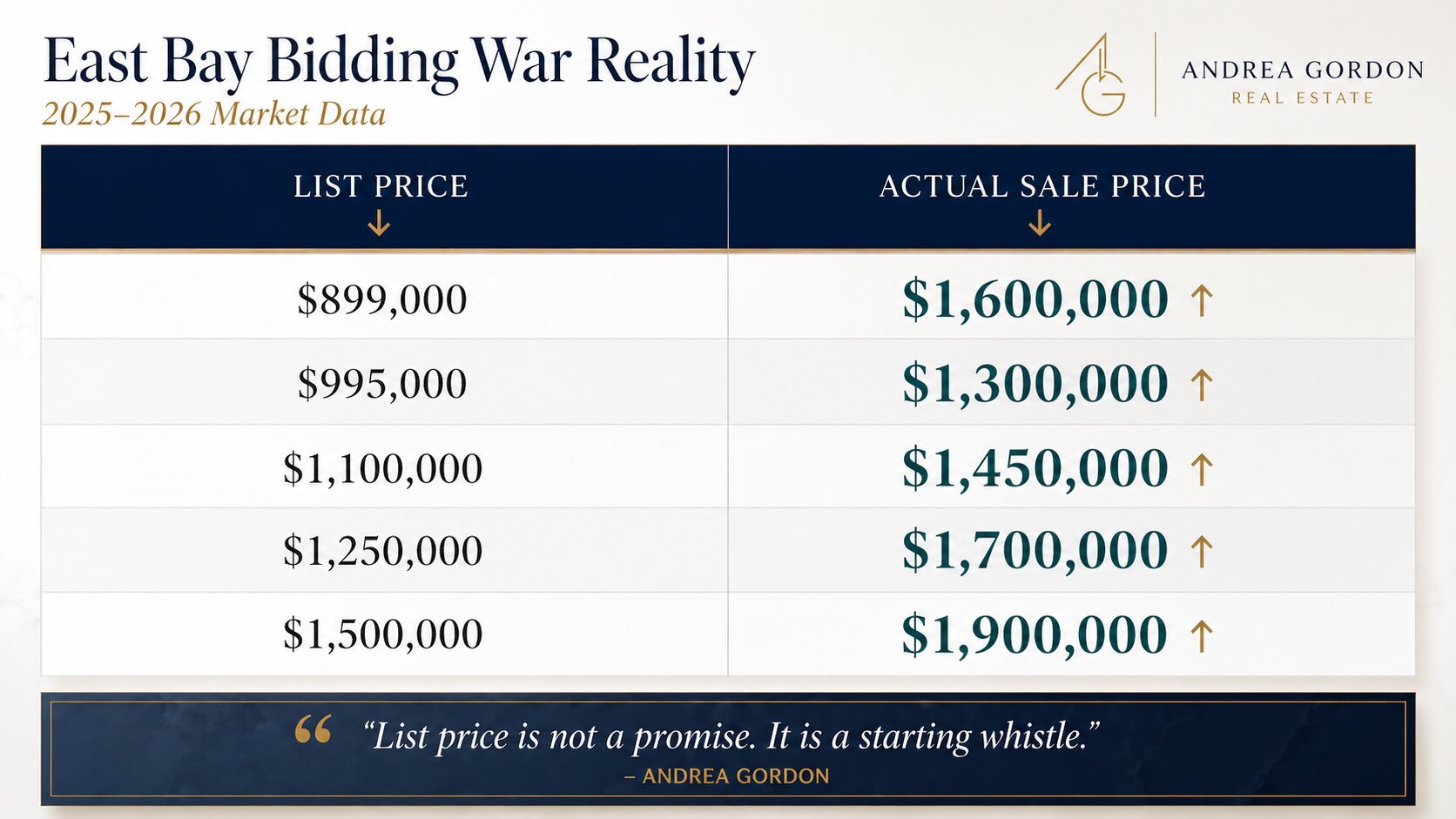
I recently participated in a bidding war on Colton in Montclair. The home was listed for $995,000. I heard it went above $1,000,600. My buyers came in at $1,000,300 and landed in the bottom third of offers.
Part of my job is bringing people back down to earth. I prepare a Comparative Market Analysis (CMA) every single time my clients write an offer. The list price is not a promise. It is a starting whistle. My job is to tell them where the finish line actually sits. For a deeper look at protecting your transactions, check out real estate risk management.
Transparent pricing real estate means respecting the buyer's intelligence. When a market forces listing agents to underprice to avoid looking bad, that respect disappears.
"What should have happened, honestly, is buyers should be paying their agents and sellers should be paying their agents—that would've been clear, clean, and easy to stomach. Whereas now, you have a lot of younger agents who haven't been in the business for very long, and it's really tough to ask your buyers to pay you when they never have had to before."–
Understanding Buyer Broker Agreements After the Settlement
The NAR DOJ lawsuit impact has created a mess I am happy to untangle. The NAR commission settlement took effect on August 17, 2024. It eliminated offers of cooperative compensation on the MLS and mandated written buyer broker agreements before agents can show properties. As of 2026, the second payment of $72 million has been delivered, but the rule changes are now permanent.
I am 69 years old. I will tell anyone the truth. Younger agents do not have that luxury. They are terrified of the conversation. But the conversation is unavoidable now.
Here is what I tell agents. In 90 percent of cases, the seller is still paying the commission. The forms changed. The mechanics did not. But you must ask for your commission percentage on the new purchase contract forms. If the seller comes back offering only one percent, your buyer has already agreed to cover the remaining two and a half percent. That is why the agreement exists. You work hard. You deserve to be paid.
To understand how market shifts affect your strategy, read insights on market trends and strategy. The NAR DOJ lawsuit impact requires agents to clearly articulate their value rather than relying on old habits. That is professional accountability.
The National Association of Realtors has published updated guidance on cooperative compensation, emphasizing that buyers and sellers can still negotiate commission structures. Transparency is not the enemy. Silence was.
Listing Agent Trajectory: From Buyer Agent to Listing Expert
Greg asked a question many new agents wonder privately. Do you start mostly on the buy side?
Yes. Absolutely. The typical listing agent trajectory begins with five years of buyer representation.
"If you show up at a listing appointment and I show up for a $3 million house, which agent is the seller going to pick? The reason why is because it's such an important asset that it will be very unusual if they would pick the less experienced agent. So because of that, a very typical listing agent trajectory in real estate is for a buyer agent to work with somebody, and then five or seven years after they've bought that house, they call that agent up and want to list that house because they're ready for the next move."–
You build the trust first. You sell the condos. You sell the smaller homes. You get your feet wet. Then seven years later, when they outgrow that home, you are the first person they call for the $3 million listing.
Do not be an elitist jerk. When a downturn comes, the $3 million homes sit still. The lower end keeps food on your table.
I sold trailers when I started. I sold condos. Those people sent me gift baskets. Once you get over $2 million, they expect you to buy them a refrigerator.
I recently sold a commercial condo for $239,000. It was an optician's space. The client's parents were retiring. It took the same amount of time and energy as a $2.3 million sale. But it deepened a relationship. When those clients go to sell their home in San Ramon, do you think they are not going to call me?
That is strategic thinking. Learn more about a journey of resilience and reinvention in real estate to see how other agents built their careers from the ground up.
The Solo Producer vs. The Massive Team
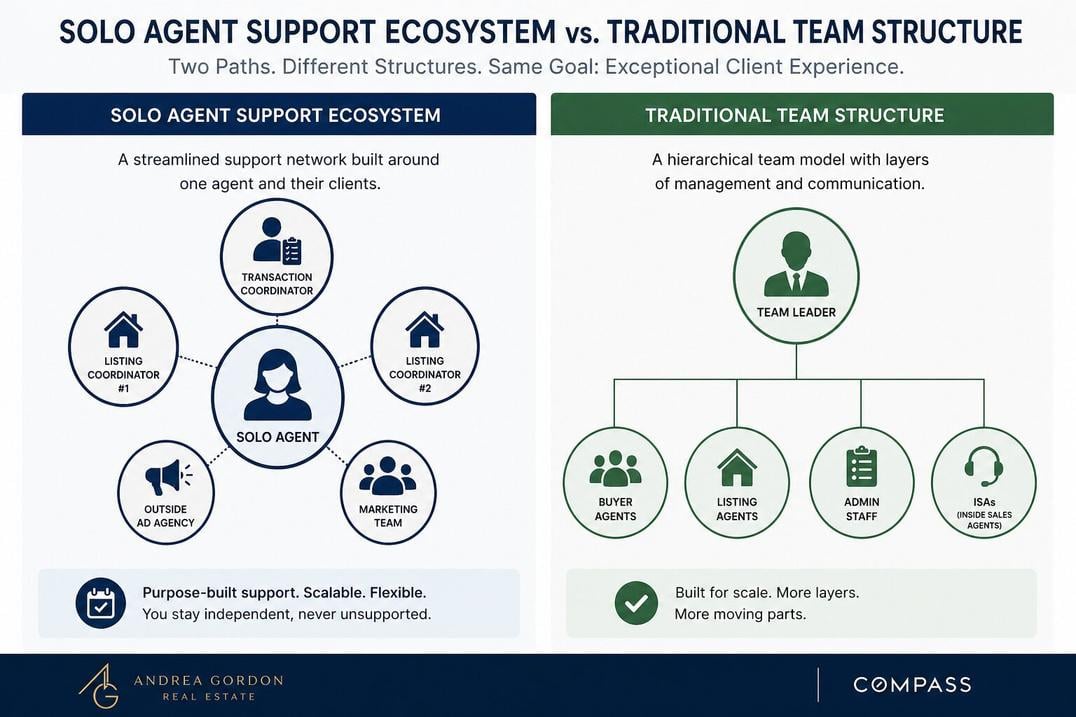
Greg Verhey Pellego Real Estate agent asked me whether I run a large team. I do not.
When you lead a team, you become a cheerleader. An educator. A therapist. I did not sign up to manage grown adults through their daily crises. My business is 92 percent listings. My typical buyer is a seller I have already sold a house to.
Here is how I built my support ecosystem. I have two listing coordinators who also act as buyer agents for referrals. They pay me a referral fee when they close a deal from a lead I passed. I have a dedicated transaction coordinator provided through Compass. I have a marketing team at Compass. And I work with an outside ad agency called Agent Upgrade to handle the relentless pace of social media.
I do not need a team. I need systems.
What works for me may not work for you. Some agents thrive as team leaders. That is fine. But know what you are signing up for. Leadership is not a promotion. It is a different job entirely. For a practical guide, read how I built a high-volume real estate business without losing personal service.
Real Estate Marketing Systems That Actually Scale

Greg wanted to know how I fill my pipeline. My real estate marketing systems are simple but relentless. I am already trolling for next year's business. Right now I have 26 listings lined up waiting to come on the market.
Here is my daily consistency. I try to make contact with five people every day. I send a newsletter once a month. I push statistical updates twice a month. I am on all social media platforms daily through Agent Upgrade. I send just-listed and just-sold cards for every single property.
Every marketing piece has a call to action. Call me for a CMA. Let me evaluate your home's marketability. Direct action. No fluff.
My real estate marketing systems include bus benches up and down College Avenue. People recognize my name even if they have never met me. I write real estate articles for Montclair Living and Berkeley Hills Living. I host this podcast. I am about to publish a book called Realizations.
Find the places where you can be the expert. If you used to be a physical trainer, write for fitness publications. The people who can afford a trainer can afford a house. Market to your sphere. Do not be afraid to say, "I started a new business. Would you support me?" Nine times out of ten, they will.
Greg's approach to building trust is worth exploring. You can learn more about Greg Verhey on his website to see how he combines fitness coaching skills with real estate.
What This Conversation Reminded Me
Reflecting on my talk with Pellego agent Greg Verhey, one truth rose to the surface again.
"Don't be over-awed by people; they put their pants on every morning just like you do. What the clients are paying us for is to tell them the truth. Even if you think in the short run it's going to make somebody not like you, don't care about that—just tell them the truth. We are here to be absolutely great with information for people in a world of AI and Zillow; if we aren't doing that, what is our purpose?"–
I have made this mistake. I once had a very famous client. I was so overwhelmed that I did not level with them about a foundation issue. I thought the magnificence of their home would make buyers overlook it. It did not. I cost everyone time and money because I was too impressed to speak plainly.
Do not do that.
Document everything. In a litigious region like the Bay Area, honesty and records are your only shield. According to First American Title, real estate litigation in California increased by 18 percent in 2025, driven largely by disclosure disputes. Median home prices in Berkeley approach $1.2 million. Oakland is not far behind. These clients can afford lawyers. They will go after errors and omissions insurance even if you did nothing wrong.
To build a stable lead pipeline, explore real estate referral network strategies that keep your business growing.
The Cost of Underpricing in a Shifting Market
The 2026 East Bay market is location-driven. Some neighborhoods are cooling. Montclair and Rockridge homes over $1.2 million are sitting longer. But Alameda single-family homes near the beach still sell in a weekend. Walnut Creek and Lafayette homes in top school zones still attract multiple offers.
For sellers, this means strategic pricing is non-negotiable. In softening areas, price just below comps to create urgency. For buyers, focus on homes that have been on the market 15 days or more. That is where negotiation power lives.
But do not confuse strategy with manipulation. The worst underpricing abuses drain everyone's energy and create distrust.
If you are a seller wondering what your property might be worth in this market, a free home value estimate can give you data-backed clarity.
Final Words for New Agents
Greg represents the next generation. He came from fitness training. I came from theater production. The skill sets are analogous. Both require presence, performance, and the ability to do what you said you would do.
If you are a new agent, plumb your sphere. Use your past career as a branding piece. Explain why being a trainer makes you a great agent. Do not hide from your lack of experience. Sell your hunger.
Show up on time. Return every call. Be present.
And for the love of everything, tell the truth.
Want to hear the full conversation between Andrea and Greg? They unpack how underpricing distorts the East Bay market, what the NAR settlement means for buyer broker agreements, and the real path from new agent to listing expert. Tune into the REalizations Podcast episode.
FAQ
1. How should agents handle buyer broker agreements after the NAR settlement?
Be authentic and tell the truth. Explain the forms have changed but the mechanics of who pays often remain the same. The agreement ensures you are compensated for your work. Do not shy away from the conversation.
2. Is it better to join a team or work solo?
That depends entirely on your goals. A team offers mentorship but takes a cut of your commission. Working solo with strong support staff allows more control and higher margins if you have the systems in place. Neither path is wrong. Know yourself first.
3. How can a new agent compete for listings against veterans?
Focus on your sphere of influence. Use your past background to build an authentic brand. Do not be afraid to ask your network for support. Sell your energy, your responsiveness, and your commitment to working harder than anyone else.
The 2026 East Bay real estate landscape is shifting toward a more balanced market with rising inventory and moderating price growth. That means an opportunity for agents willing to do the work.
If you are ready to sell, a consultation for home sellers can help you craft a winning pricing and marketing strategy.
Apply as a Guest Speaker
Real estate is evolving. The legal landscape is shifting. The way we price homes is under a microscope. If you are actively working in the industry and solving real problems, whether you are a veteran or a rising agent like Greg, apply to share your story on the podcast.