
Most agents treat a real estate business plan like a document they file once a year and never look at again. I treat mine like a survival system because that's exactly what it is.
I've built my real estate career in the Bay Area over decades, and in that time I've:
-
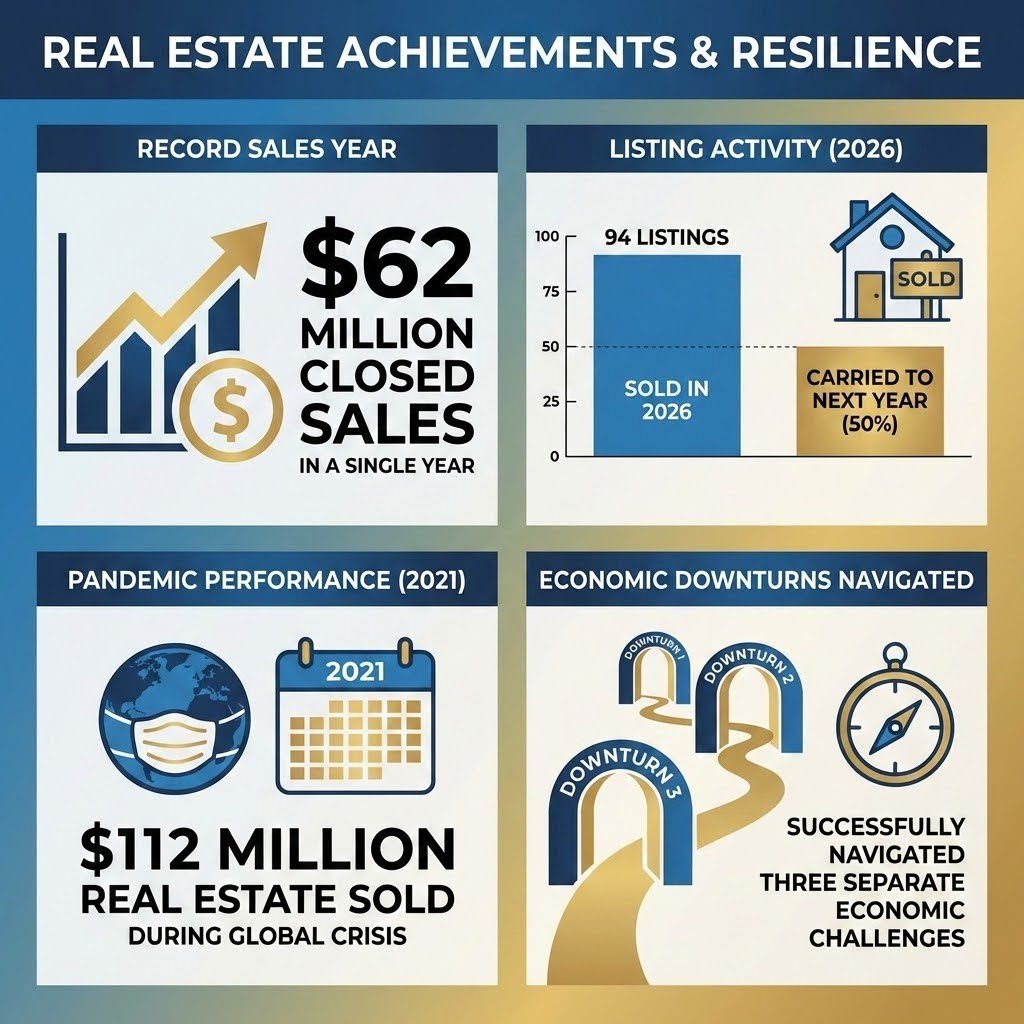
Closed $62 million in sales in a single year,
-
Took 94 listings in 2026, with 50% going into next year
-
Sold $112 million worth of real estate during the pandemic in 2021, and
-
Navigated three separate economic downturns.
None of that happened by accident. It happened because I had a real estate business plan built for pressure, not just growth.
"I've survived three economic downturns as a realtor. The first economic downturn taught me that there is nothing that's going to happen in real estate that's going to kill you. There's nothing that's going to happen pretty much anywhere in your job that's going to kill you. The things that will kill you will be like a bus, a mountain or disease. So, get over it."— Andrea Gordon, Bay Area Realtor & Host of the Realizations Podcast
The framework I’m about to show you in this article is drawn directly from what actually works when markets contract, clients panic, and other agents disappear. If you want to know how to survive a real estate market crash, start here.
🎬 Get a quick look. Watch the highlights from this conversation:
▶️ Ready to go deeper? Watch or listen to the full episode:
Why Most Realtors Don't Actually Have a Real Business Plan
When the market is hot, it's easy to mistake a full pipeline for a business plan.
I did, too.
The first time the market turned, I had:
-
No buffer
-
No systems
-
No financial infrastructure.
I was generous to a fault, picking up tabs, spending freely, and when things slowed down, I had nothing to fall back on.
"The first economic downturn, I got caught with my pants down. I had spent too much money. I'd been way too generous buying drinks for everybody at the bar, doing this, that, and the other thing. And I realized after that, I've got to put a plan in place. I've got to get financially savvy." — Andrea Gordon, Bay Area Realtor & Host of the Realizations Podcast
As I’ve shared in the podcast episode with James Short, I quickly realized that, without a real estate business plan, you're reactive.
You're a bumper car, bouncing off whatever the market throws at you. And when the market contracts, reactivity becomes expensive for your real estate business.
Study shows 82% of small businesses fail because of cash flow mismanagement. This proves that when transactions slow, the agents without a financial structure feel it first.
So, you need to establish a financial structure.
Thankfully, having a recession-proof real estate business isn't about luck or timing, but about building something that works regardless of what the economy is doing.
In the next section, I’ll show you the 7-part framework that will help you build a recession-proof real estate business.
Case Study: $112 Million During the Pandemic
In 2021, I sold $112 million of real estate. I wasn’t lucky. I was prepared. During the pandemic the market panicked, buyers froze, and many agents disappeared.
My systems didn’t. They ran whether I felt like it or not, and they kept me standing when everyone else was falling.
"I sold $112 million worth of real estate in 2021…I've closed $62 million in sales this year." — Andrea Gordon, Bay Area Realtor
Those numbers are the proof of concept for everything in this framework.
The pandemic didn't exempt anyone from fear or uncertainty. But it did separate agents with real estate systems from those without them.
Here’s a snapshot of the 7 core pillars I used to get these kinds of results despite downturns:
|
Pillar |
What To Do |
|
1. Financial Infrastructure |
Hire a bookkeeper, financial planner, and accountant, and review your numbers monthly. |
|
2. Systems Over Emotion |
Create written processes for listings, marketing, and follow-up so you never rely on motivation. |
|
3. Marketing Discipline During Downturns |
Increase your marketing budget when the market slows instead of cutting it. |
|
4. Planning 12 Months Ahead |
Start planning next year’s pipeline in October and finalize your business plan in November. |
|
5. Emotional Intelligence & Closing Psychology |
Anticipate buyer fear and proactively remove obstacles before they derail the deal. |
|
6. Coaching & Accountability |
Work with a business coach who challenges your mindset and tracks your performance. |
|
7. Sophistication for Sophisticated Clients |
Learn how bonds, interest rates, and financing work so you can answer advanced client questions confidently. |
The 7-Pillar Recession-Resistant Real Estate Business Plan Framework
Over three downturns, I've refined everything I do into seven core pillars.
Together, they form a real estate business plan that doesn't just survive hard markets, but performs through them.
Pillar 1: Financial Infrastructure
Hire Your Three Financial Professionals
Real estate financial planning isn't something you can DIY at tax time. If you're running a serious business (and you are) you need a dedicated financial team. Not someday. Now.
"I have a bookkeeper, a financial planner, and an accountant. So, I have three people on my financial staff taking care of this stuff for me." — Andrea Gordon, Bay Area Realtor
Here’s what a solid financial team does for your business.
|
Role |
What They Protect |
So That You Can… |
|
Bookkeeper |
Cash flow visibility and accurate monthly reporting |
Make informed decisions before problems become emergencies |
|
Financial Planner |
Long-term wealth growth and investment positioning |
Turn commissions into lasting wealth instead of temporary income |
|
Accountant |
Tax efficiency and compliance |
Keep more of what you earn and avoid costly surprises |
They are the three professionals whose sole job is to protect what I build.
Most agents have none. That gap becomes catastrophic in a downturn, when cash flow tightens, and decisions need to be made fast.
Shift Your Mindset From Employee to Owner
According to the National Association of Realtors:
Of the 1.5 million members of the National Association of REALTORS® (NAR), approximately 87 percent are classified as independent contractors. -National Association of Realtors
That means most Realtors are not employees. They are business owners.
There is no employer safety net. No guaranteed salary. No HR department reviewing the margins for you.
-
If revenue drops, you absorb it.
-
If taxes are mismanaged, you pay for it.
-
If cash flow dries up, the responsibility is yours.
That’s why your financial structure is your responsibility.
"I think people should have classes in finance for realtors because anybody who is an entrepreneur like a realtor is — remember, when you work for a company, I don't work for Compass. As far as I'm concerned, Compass works for me." — Andrea Gordon, Bay Area Realtor
That mindset shift — from employee to owner — changes everything.
When you see yourself as the business, you don’t hope things work out. You build systems that protect you when they don’t.
Pillar 2: Systems Over Emotion
Before going into real estate, I spent nearly three decades in theater as a director, writer, and producer. That background shaped how I run my business.
Specifically, this distinction: a director builds the structure so the performance can happen reliably. The actor reacts in the moment. The director has already planned for every moment.
In real estate, your job is to be the director. You're not the one having the big emotions; you're the one managing them.
And that only works if you've built the structure to hold everything together when things get loud.
That structure is systems.
"I like things to be orderly. I have systems in place for pretty much everything. And I know that that's boring to people. They hear systems. Oh, yeah. But the reality is, if you don't have a system in place, you cannot treat real estate like a job. You'll just be like a bumper car bouncing from one place to the next." — Andrea Gordon, Bay Area Realtor & Host of the Realizations Podcast
Real estate systems for agents aren't glamorous. But they're the difference between an agent who has a good year when the market cooperates and an agent who produces consistently regardless of conditions.
Pillar 3: Marketing Discipline During Downturns
Here's where most agents get it backwards. When the market softens, they pull back on marketing to conserve cash. I do the opposite.
Real estate marketing during downturn is when visibility matters most — because your competition has gone quiet. A McGraw-Hill study found that companies that kept advertising during the 1980s recession grew 275% more than those that cut.
The same logic applies to real estate.
"When the economy goes down, I actually increase my marketing budget." — Andrea Gordon, Bay Area Realtor
Because of this, I market every single month without fail.
It doesn't matter what the market is doing — good quarter, bad quarter, election year, pandemic.
Consistency is what builds the pipeline that carries you through slow periods and positions you to dominate when things pick back up.
Pillar 4: Planning 12 Months Ahead
Real estate business planning for agents needs a fixed rhythm. I start building my pipeline in October, and I'm formally planning for the following year by November.
So when January hits, I'm not starting from scratch.
Most agents are still reacting to the current quarter. I'm already building the next one.
"I took 94 listings this year. About 50% of them are going into next year because I start a pipeline for my next year. I start thinking in October about the following year. I also business plan in November." — Andrea Gordon, Bay Area Realtor
Reactive Planning vs. Strategic Planning
|
Reactive Agent |
Strategic Agent |
|
Plans quarter to quarter |
Plans 12 months ahead |
|
Starts January hunting for listings |
Starts January with listings already in motion |
|
Responds to market shifts |
Anticipates production cycles |
|
Lives in feast-or-famine swings |
Maintains a stable pipeline |
That 12-month pipeline mentality is exactly how you avoid the feast-or-famine cycle.
When other agents are scrambling for listings in January, I already have 47 in progress.
When you have listings already in motion for the next year, you don’t make desperate decisions in the current one.
Pillar 5: Emotional Intelligence & Closing Psychology
People hire me at some of the most significant moments of their lives:
-
A new baby
-
A divorce
-
A death
-
A job change.
If you can't handle those emotions, you won't last in this business. And if you can read the room, you'll close deals others walk away from.
That's where the word I picked up in my PhD program comes in: chyros
Research shows 90% of top performers are high in emotional intelligence. And chyros is having the emotional intelligence and the ability to innately understand and read the room, a skill any agent can develop deliberately.
"Chyros is the ability to innately understand and read the room. Developing chyros is a super skill for real estate salespeople." — Andrea Gordon, Bay Area Realtor
Here’s what chyros looks like in practice:
-
You notice hesitation before it becomes an objection
-
You adjust tone based on the client's emotional state
-
You pause instead of filling silence
-
You separate fear from rejection
Nowhere does this matter more than at the closing table. Psychologists have found that people feel the pain of losing money more sharply than the excitement of gaining something of equal value — and in a $1.2 million transaction, that fear hits hard. A buyer who can actually see themselves in a home doesn't look excited. They look terrified. That's your cue.
"If somebody walks into a house and sees something that they could buy, their first look is not one of ecstasy. It's one of horror because they're like, 'Oh my God, I might actually spend this kind of money.' And then the very next thing they do is start trying to find the obstacles. Your job is to make sure that those obstacles don't stop them from getting what they want all the way down to the finish line." — Andrea Gordon, Bay Area Realtor
Your role in that moment is to help clients move through fear without amplifying it.
Pillar 6: Coaching & Accountability
Every serious professional has a coach. Athletes, executives, surgeons.
Why would real estate be different?
The Institute of Coaching found that 70% of people who receive coaching report improved work performance, and 86% recover their investment in coaching.
"Business coaching is absolutely important. You have to have a coach." — Andrea Gordon, Bay Area Realtor
So if you’re serious about going “high-level”, real estate coaching for agents is non-negotiable.
How to Find the Right Coach for Your Real Estate Business
According to Real Trends Verified, to find the right coach, you need to consider the following:
|
Requirement |
Ask Yourself… |
|
Proven Track Record |
Do they have clear evidence of helping agents grow? Are their client results consistent, not one-off wins? |
|
Relatability |
Do I respect how they think and operate? Can I see myself taking direction from this person? |
|
Accessibility |
Will I have meaningful access when challenges arise? Does their communication structure fit my needs? |
|
Cost Alignment |
Does the potential return justify the investment? Am I viewing this as an expense or a growth asset? |
|
Innovation |
Are they offering insight beyond what I can Google? Do their ideas feel current and market-aware? |
|
Familiarity with Pitfalls |
Do they understand the specific challenges agents face? Have they solved these problems repeatedly? |
|
Lead Generation Expertise |
Can they clearly explain how they improve lead flow? Does their system match my market and price point? |
|
Long-Term Development |
Will this coach still challenge me two years from now? Is there a roadmap beyond my current production level? |
Pillar 7: Sophistication to Match Sophisticated Clients
When someone is buying a $2 million property, they've done well for themselves.
They will expect you to match their level.
If you can't speak intelligently about the bond market, interest rates, or economic conditions, you will lose that client.
"If they ask you a question about interest rates, you need to know that mortgages don't necessarily go down when the interest rate goes down because they're tied to the bond. You need to understand what the bond market is because you need to be able to talk intelligently and coherently with your folks about these kinds of things." — Andrea Gordon, Bay Area Realtor
Real estate financial planning is about being fluent enough in financial language to earn the trust of high-net-worth clients, especially in uncertain markets.
Hiring for Hunger, Not Comfort
Team-building is also something I covered in depth in my interview with James Short. And it comes down to three things: who you hire, when to let go, and how to manage the cycle.
Hire “Hungry” Assistants
The best assistants are hungry. They want to learn everything you know, absorb how you operate, and eventually outgrow the role.
Expect them to stay two years and move on. That's the model.
"If they're not hungry like that, you don't even want to work with them." — Andrea Gordon, Bay Area Realtor
Know When To Let Go
When someone stops growing, it shows. I've let go of assistants I genuinely liked, not because they were bad, but because they were too good for the job. Keeping someone in a role that's too small for them doesn't serve either of you.
"I'm not firing you because you're not good. I'm firing you because you need to do something with your life that's better than this." — Andrea Gordon, Bay Area Realtor
Follow These Three Rules
-
Pay well. Talented people have options. Give them a reason to stay while they're with you.
-
Recruit constantly. Don't wait for a vacancy to start looking.
-
Plan for turnover. An assistant without ambition won't push your business forward.
The Mindset That Makes a Real Estate Business Plan Work
Frameworks, systems, and financial teams only go so far.
The seven pillars only work if you're willing to execute them through uncertainty, and that requires a specific relationship with failure.
I have a paperweight on my desk that reads: "What would you attempt to do if you knew you could not fail?"
I've used it as a compass for decades. Because in this business, how you interpret setbacks determines everything.
And that compass allowed me to see failure, downturns, and mistakes not as dead ends, but as the very things that reshaped how I operated next:
-
My first economic downturn taught me financial discipline.
-
The second proved my systems worked.
-
The third confirmed that this real estate recession strategy, built on infrastructure, survives anything the market does.
"I feel like I would have to hunt for something that I truly regret because I believe that every failure I’ve ever had has brought me to the place that I’m at now…There is no such thing as failure, and there should be no such thing as regrets." — Andrea Gordon, Bay Area Realtor & Host of the Realizations Podcast
Recession-Resistant Real Estate Business Plan: Quick Checklist
- Build a financial team: bookkeeper, financial planner, accountant
- Install systems for marketing, follow-up, and operations
- Increase your marketing budget when the market slows
- Start next year's pipeline in October; business plan in November
- Develop emotional intelligence. Read the room and close with confidence
- Hire a business coach and commit to accountability
- Build financial literacy to match your clients' sophistication
- Hire hungry assistants; pay well, expect turnover, and recruit constantly
Want to build a real estate business plan built to last?Learn directly from my experience through my Realizations Podcast where I interview the real people shaping real estate, from mayors and city planners to top producers and industry leaders.But if you're a real estate professional looking to grow smarter and share your own insights with a national audience, join the Icons of Real Estate Podcast Network, a community of agents and leaders using podcasting to build authority and generate business. |
|---|
FAQ On How to Survive a Real Estate Market Crash
How often should Realtors update their real estate business plan?
At minimum, once a year, but high-performers review it more frequently. Starting the planning cycle in October means you enter the new year with a pipeline already in motion, not a blank page.
Should you increase marketing during a downturn?
Yes. Real estate marketing during downturn is a contrarian strategy that works precisely because most agents pull back. When competitors go quiet, consistent visibility pays off disproportionately.
What financial team should Realtors have?
At minimum: a bookkeeper, a financial planner, and an accountant. These three roles address day-to-day tracking, long-term wealth strategy, and tax compliance, three very different skill sets that one person can rarely cover alone.
How do you recession-proof a real estate business?
Recession proof real estate business is all about building infrastructure. I’m talking about setting up systems, financial planning, pipeline management, hiring a business coach, and practicing emotional intelligence. Together, they’ll help you create a business that performs regardless of market conditions.
This podcast is produced by the Icons of Real Estate — #1 Real Estate Podcast Network.
Apply to Be a Guest on the REalizations Podcast
If you serve the real estate industry through staffing, lending, brokerage, technology, or advisory, and help agents grow smarter, not harder…
Let's spotlight your insights.
Apply to be featured on the Realizations Podcast.