
When a buyer asks ChatGPT who the best agent in your area is, the answer is not magic. AI engines pull from publicly available data, weigh third-party signals far more than your own website, and serve a ranked recommendation in seconds. The agents who understand this now will leapfrog competitors who wait.
Check out the preview of this episode:
I learned that firsthand. Over the last month and a half, five separate clients told me ChatGPT had named me the top agent in Berkeley, California. So on a recent REalizations episode, I sat down with Steve Marcinuk of Keycrew Media to reverse-engineer exactly what happens under the hood of modern search.
Watch the full episode:
Why I Had This Conversation About AI Real Estate Search
I started this podcast because I got furious during the NAR DOJ lawsuits and the commission shakeups. I could stay angry for years, or channel that energy into something useful. I chose the second path: pulling back the curtain on what top producers actually do.
Those frustrations were real. In March 2024, the National Association of Realtors agreed to a $418 million settlement that reshaped how commissions work, with new rules taking effect that August. That upheaval is exactly the kind of disruption that makes a conversation about AI-driven search engines for real estate agents feel urgent. If you want the broader picture on where the market is heading, my earlier reflections on making sense of the real estate market set the stage.
How AI Search Engines Secretly Rank Your Business
Most agents assume engines like ChatGPT, Claude, and Perplexity run on deep, untraceable intelligence. Steve corrected that fast. He described AI search as essentially three Google searches wrapped up in a trench coat. These platforms crawl public data in real time, package it, and hand it to the consumer.
If you have decades of momentum, the AI finds you naturally. But for newer agents, this shift is a wide-open window. Steve compared it to a thunderstorm hitting a car race. In perfect conditions, overtaking the leader is nearly impossible. When it rains, all bets are off. This sudden change in how consumers gather local data means you can aggressively pass established competitors, as long as you know which signals to feed the algorithms. This mirrors what McKinsey describes as a new front door to the internet, where roughly half of consumers now intentionally use AI-powered search to guide buying decisions.
Optimizing Your Digital Footprint for AI Visibility
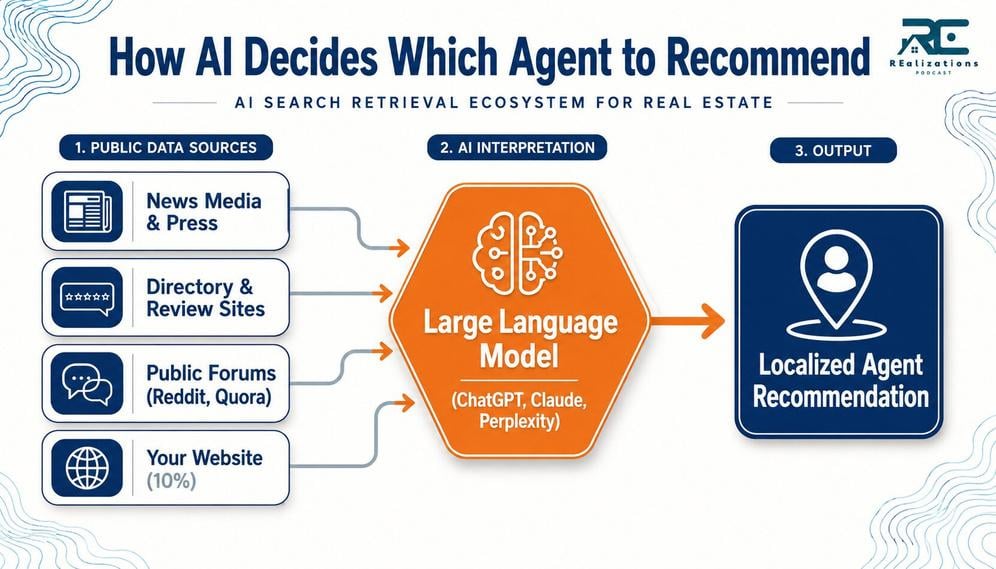
Here is the part that surprised me most. Positioning your brand for real estate media visibility means looking far past your own website. According to Steve, your site dictates only about 10% of what shapes AI search results. The rest comes from third-party validation you do not directly control.
To build local authority, you have to raise the tide across many external channels at once. AI leans heavily on news media, press releases, public discussions on forums like Reddit, and local directory reviews.
"AI is surfacing intelligence from a bunch of places. Generally speaking, 10% of what influences AI search, according to McKinsey and our own tests, is your own website. What you put on your own website matters. There's also a certain influence that comes from social media platforms. But for better or worse, a lot of what's influencing this is what you don't have direct control over. That's other people's websites. So, the news media, huge influence. That's a primary source. What's published by third-party media, that's a very big part of it.
That 10% figure is not just an internal estimate. Independent analysis of McKinsey's research confirms that brand-owned pages often make up only 5 to 10% of the sources AI uses to build an answer, while publishers, reviews, and user-generated content dominate. The channels that actually feed the algorithms break down into a few clear groups.
Your owned channels, worth roughly that 10%, include your primary website, local blog posts, and internal landing pages. Beyond that sit public forums and social spaces, the active threads on Reddit, Quora, and social networks where real-time local conversations unfold. Then comes third-party media and press, meaning editorial coverage, announcements, and digital real estate publications. Finally, directory and review infrastructure carries real weight, since high-authority directories and verified review platforms help algorithms confirm who dominates a local market. Steve's own writing on why generative AI may outgrow social media for agents digs deeper into this discovery shift.
The Future of Realtors in an AI World
The future of realtors in the AI world is a real anxiety that dominates our industry: the fear of being automated out of existence. A handful of radical startups are trying to remove agents from transactions entirely. But Steve, who interviews hundreds of market experts every month, sees a different reality. Real estate remains the largest financial and emotional asset in a person's life, and demand for a trusted human advisor is intensifying.
Rather than replacing agents, AI is acting as an educational equalizer. Buyers and sellers now pull comps, analyze basic trends, and touch up property photos before they ever call. Because clients arrive with surface-level knowledge, our role shifts from gatekeeper of information to high-level strategic consultant.
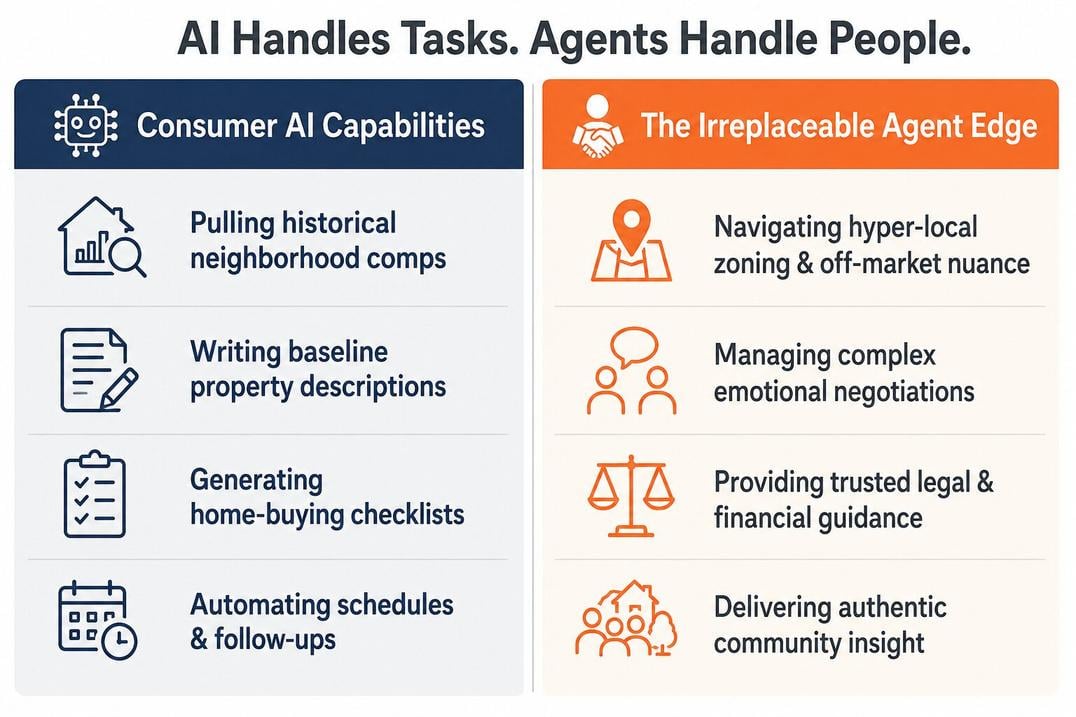
The contrast is sharp. AI pulls historical neighborhood comps; agents navigate hyper-local zoning laws and off-market nuance. AI writes baseline property descriptions; agents manage the emotional negotiations between parties. AI generates home-buying checklists and automates follow-ups; agents deliver trusted legal and financial risk guidance plus the authentic community insight no model can fake. My conversation with Greg Verhey on real estate transparency touches on this same theme of human trust in a data-flooded market.
Using Agentic AI and Connectivity to Streamline Your Marketing
Understanding how real estate agents can leverage AI starts with moving past simple call-and-response prompting.
The conversation took a fascinating technical turn when we moved past simple call-and-response prompting. The real productivity leap comes from two expansions: agentic behavior and total system connectivity. Instead of handing a tool one task and waiting, agentic AI keeps trying, adjusting each step based on feedback until it hits a complex goal.
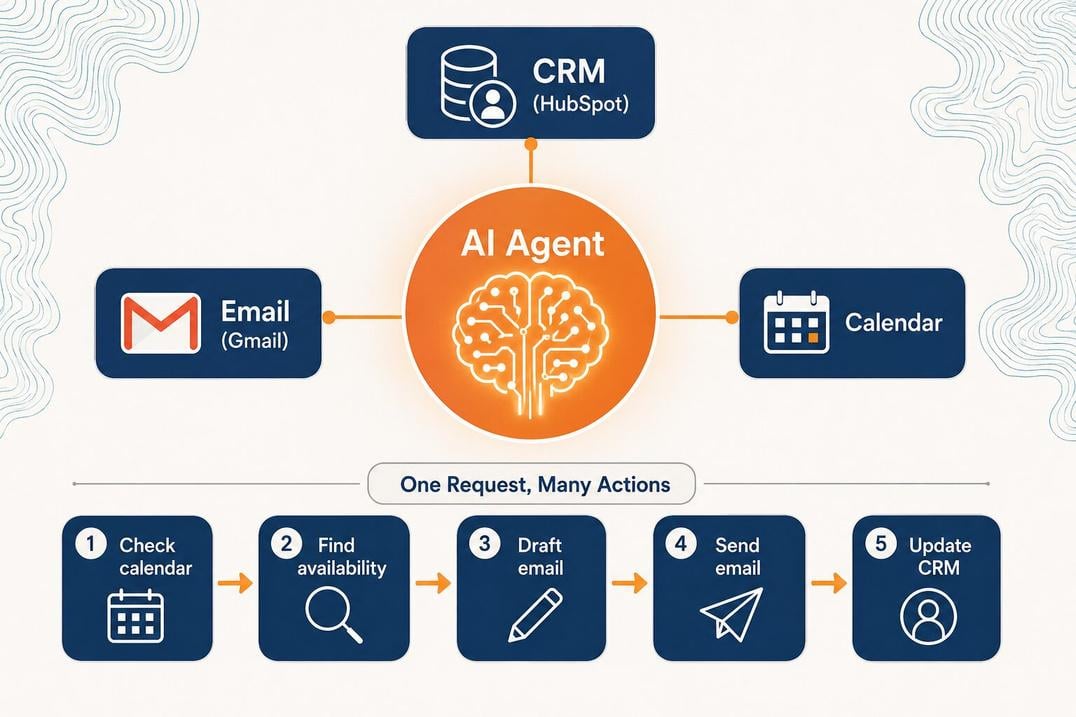
Connect that generative brain to your CRM, email, and calendar, and your administrative load evaporates. No more hours spent coordinating schedules, updating files, or sending routine follow-ups by hand.
"If you take an AI tool and it's just sitting alone without access to anything else, it's very limited in its capabilities. You have an employee, and all they have is a pencil; you're only able to do so much. But if you give them tools, right? If you give them access to your HubSpot account, you give them access to your Gmail, you give them access to your calendar, all of a sudden, you have a brain in the center of an ecosystem. We're using this daily: schedule a meeting with this person, check my calendar, find an availability, write an email with the availability, send the email, update HubSpot. That's one request."
–
That single-request workflow is no longer a theory. Steve's breakdown of how agentic AI is reshaping agent workflows in Phoenix shows it running in the field today, and McKinsey's reporting on the agentic commerce opportunity documents how these agents now compare options and complete tasks end to end.
Why Leaning Into Authenticity Was My Biggest Takeaway
AI disruption in real estate marketing is real, but hearing the editorial blueprint behind Keycrew completely shifted how I see my own approach. The company scales its reach by publishing over 500 articles a month using an AI tech stack to draft content. But the non-negotiable foundation of every single piece is a raw, human interview with a real expert.
That made something click. Trying to sound like a flawless, robotic machine online is a losing strategy. The machines already won the race for speed and volume. Our advantage is our raw, messy, hyper-local human experience.
"We have here tools that need that raw ingredient, that active ingredient from folks who know what they're talking about outside of this little world of technology, into what's actually happening. Every single article starts with a conversation with an expert who knows what's actually happening and is able to address misconceptions or educate, or has a real human perspective on an issue that's misunderstood, because AI only works with the information that's already out there. What is it that you know that the machines don't?"
–
Moving forward, I am doubling down on my authentic voice. I will use AI to streamline schedules, automate repetitive workflows, and analyze documents. I will never let it replace the personal, intuitive guidance I give my clients. If you want my fuller take on this balance, I wrote about AI and our real estate world and about real estate entrepreneurship in earlier posts. Steve Marcinuk and the team behind Keycrew Media frame his mission and share an ongoing perspective through his professional work in digital media and AI visibility.
Want to hear my entire conversation with Steve Marcinuk from Keycrew Media about how AI is secretly reshaping real estate discovery and exactly what top agents are doing to stay visible? We go much deeper on agentic AI, the specific prompts that work, and why your authentic voice is your most valuable asset in an algorithm-driven world.
Frequently Asked Questions
How do AI platforms like ChatGPT decide which real estate agents to recommend?
AI engines crawl publicly available information across the web. They read your website, but they weigh third-party validation far more heavily, including digital news coverage, press releases, local directory reviews, and organic mentions on public forums like Reddit.
Will AI technology eventually replace real estate agents?
No. AI can automate administrative tasks, property descriptions, and basic data analysis. It cannot replace the nuanced negotiation, hyper-local intuition, and emotional support required to guide the largest financial transaction of a person's life.
What is the quickest way for a new agent to build AI search authority?
Focus on generating third-party signals. Secure local media coverage, publish human-driven insights on high-authority platforms, keep your profiles updated on major real estate directories, and make sure clients leave consistent, descriptive reviews online.
Apply as a Guest Speaker
The real estate landscape is shifting underneath our feet. AI algorithms are rewriting the rules of marketing, commission structures are evolving, and consumer expectations have transformed completely. If you want your business to survive and dominate this disruption, you cannot afford to stay invisible.
If you are an active real estate professional, developer, lender, or industry vendor solving real-world problems and building an authentic brand, we want to feature your expertise on the Icons of Real Estate network. Share your story, capture high-authority media visibility, and position your business where the future of search is already looking.