Burnout is the quiet epidemic of this business. The phone never stops ringing. Your calendar bleeds into every weekend. Somewhere along the way, the career you fell in love with starts running you instead of the other way around.
That tension sat at the center of my latest conversation on REalizations. I sat down with Lauren Goché of Think Real Estate, a Portland broker who hit a wall, freaked out, and then rebuilt her business on her own terms.
I have spent twenty-eight years selling real estate in Oakland and Berkeley. I have made plenty of mistakes, including the one where you convince yourself that being on call around the clock is simply the job. So when someone is this honest about the cost of that, I listen.
Here is what you will take away from our conversation:
How burnout pushed Lauren to build a team instead of grinding herself down
Why the Portland real estate market is really two markets wearing one name
How a conservative pricing strategy protects sellers better than bait pricing
Why she fights her own buyers over the inspection contingency
What it looks like to put the client ahead of the commission, every time
Or listen to the full conversation here:
Why I Had This Conversation With Lauren Goché of Think Real Estate
I started REalizations because I was furious. After the commission lawsuits, I watched people who had never sold a home in their lives decide what our profession was worth. I could stay angry for years, or I could do something useful. The podcast was me choosing useful.
So whenever I sit across from someone like Lauren, I treat it as a small act of setting the record straight. She has spent more than twelve years in the Portland market, and her team closes around fifty deals a year.
What pulled me toward this conversation was not her production. It was her honesty. She talks openly about burning out, about the ethics other agents would rather avoid, and about telling her own clients no. After my own years in this industry, I know how rare that candor is.
Most of us learn to perform confidence. Lauren just tells you the truth, and that set the tone for everything that followed.
How Burnout Pushed Her to Build a Team
Lauren hit that wall hard, and what struck me was how plainly she owned it.
"I burned out and freaked out. And then finally, I had a business coach that was like, the solution to this is help. And I was like, you don't know me. Turns out she did. So I started a team because I was in major burnout."
– Lauren Goché, Real Estate Broker, Think Real Estate
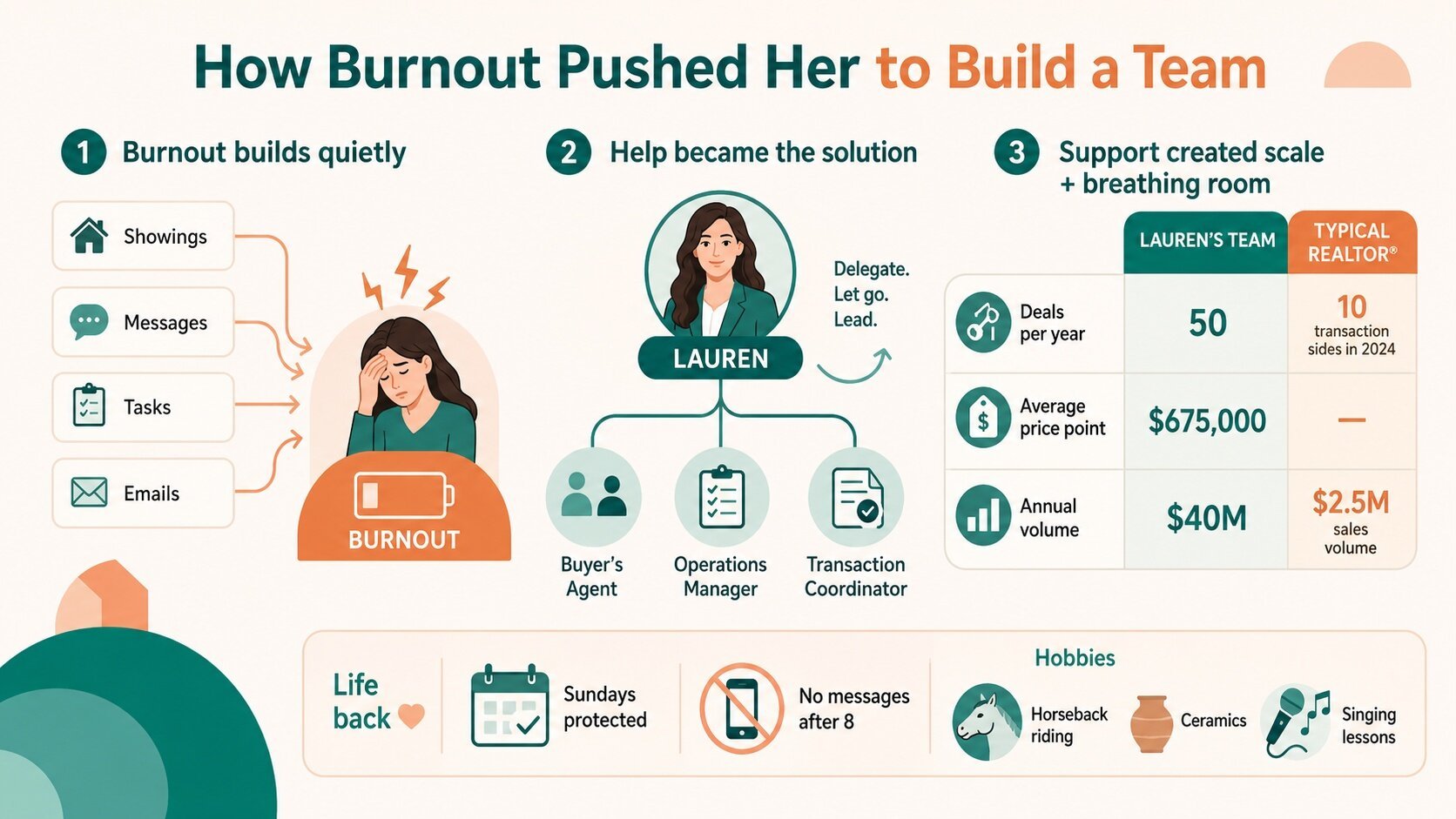
What I respect is that building a real estate team was not an ego move for her. It was survival. She hired a buyer's agent she now trusts completely. She added an operations manager and a transaction coordinator. Then she did the hardest part, which is actually letting go.
In the episode, Lauren shared that her team closes about fifty deals a year at a roughly $675,000 average price point, which works out to around $40 million in annual volume. For context, NAR’s 2025 Member Profile found that the typical REALTOR® completed 10 transaction sides in 2024, with a typical sales volume of $2.5 million.
That puts Lauren’s team production in perspective: the team model is not just giving her breathing room, it is operating far above the typical individual benchmark.
The payoff was not only production. It was getting her life back. Her team now protects Sundays and stops answering messages after eight. She filled that space with horseback riding, ceramics, and singing lessons. For an industry that runs people into the ground, that is a quietly radical move.
The “Tale of Two Markets” Inside One City
The market headlines almost never match what I see on the ground, and Lauren sees the same gap in Portland. When I asked her about inventory, she gave me the real answer, which is that the Portland real estate market is not one market at all.
Her phrase for it was the tale of two markets. Homes that are prepped, priced, and marketed well still draw multiple offers and sell over asking. The neglected ones sit while everyone blames conditions. Redfin found that in Portland, 58.7% of listings in November lingered on the market for at least 60 days without going under contract, the seventh-highest share among the 50 most populous U.S. metros. That backs up Lauren’s point: some homes are still moving, but weak positioning gets punished fast.
She lived this in February. She comped a home aggressively at $775,000 over the objections of colleagues who thought it was too high. It drew twelve offers and closed at $1.1 million.
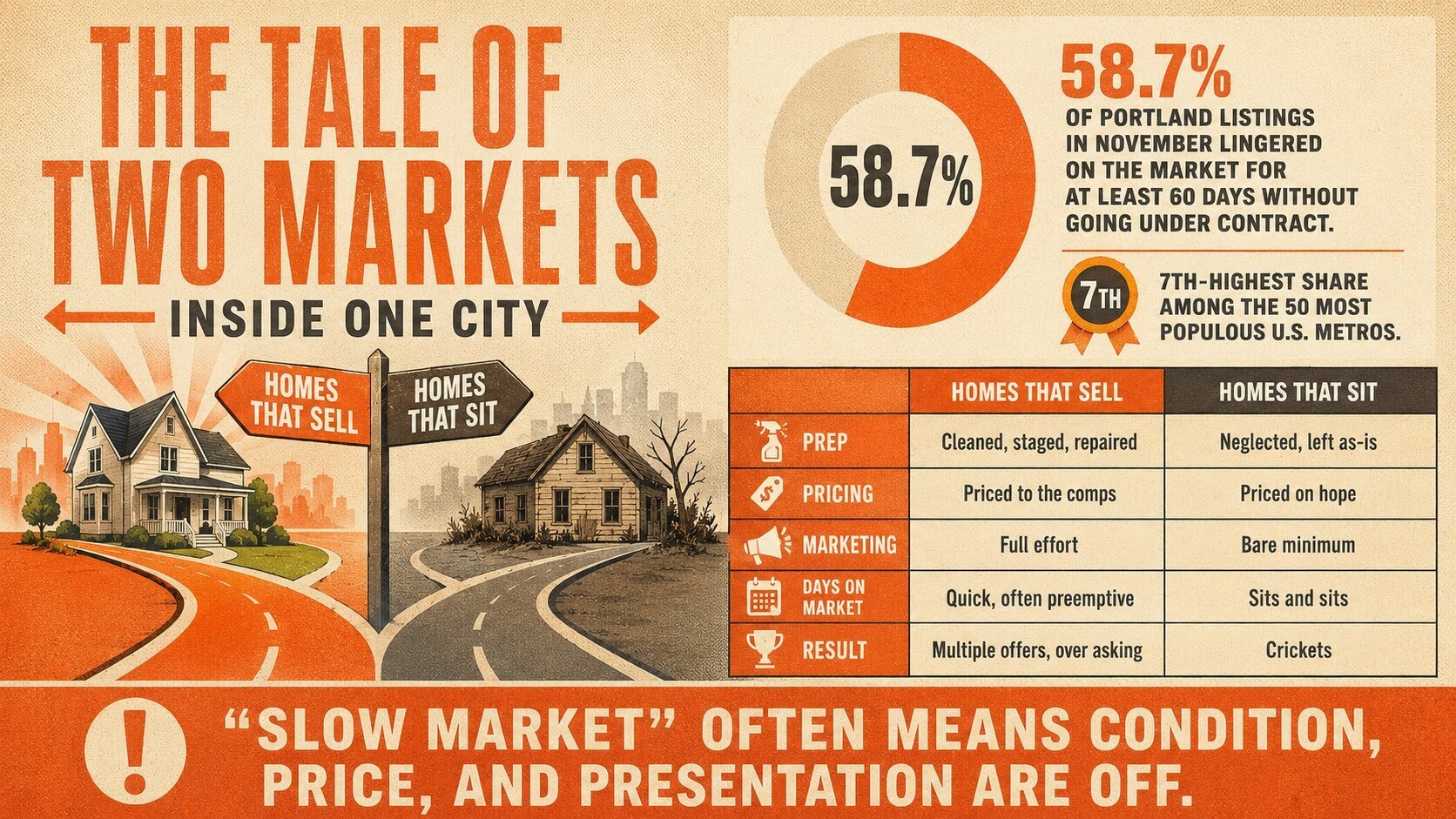
The lesson I took is simple. “The market is slow” is usually a story we tell to avoid a harder conversation about condition, price, and presentation.
Pricing With Integrity in a Game Built on Tricks. 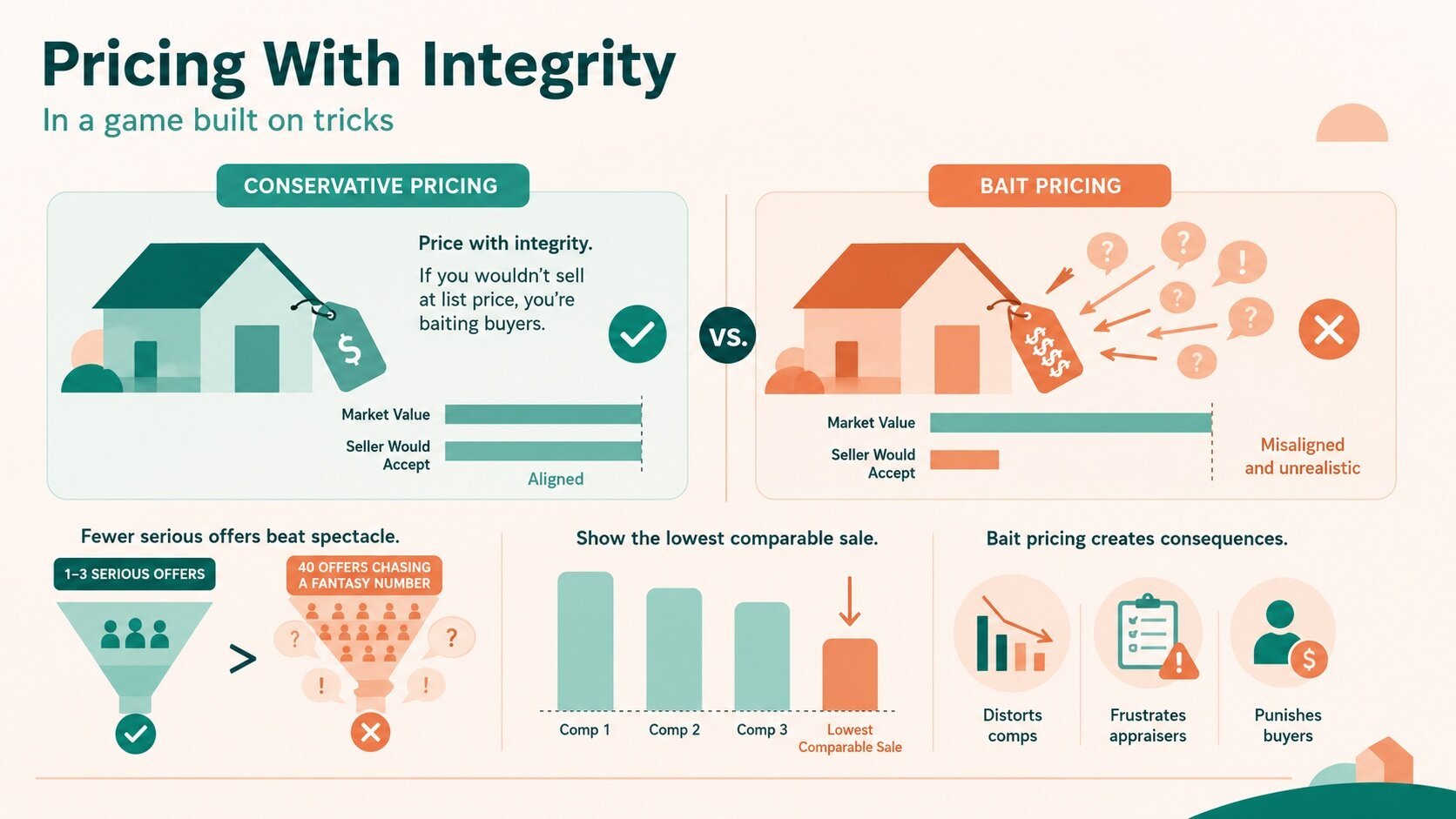
"I like to price conservatively. So if we get one offer, we're stoked, but the goal is still to get at least a couple, because that's going to be the best for the seller. But I don't want to go so low that if we get an offer for list price, my sellers would be pissed. Ethically, you can't put a house on the market unless you're willing to sell it for list price."
– Lauren Goché, Real Estate Broker, Think Real Estate
That last line is the whole game. If you would be horrified to actually sell at your own list price, you are not pricing a home. You are baiting buyers.
The way I handle it with my own sellers is to sit them down, show them the lowest comparable sale, and ask if they would accept that number. That honesty is the foundation of the Bay Area real estate seller services to list your home. Lauren reaches the same place by her own road.
Fewer offers that are all serious beats forty offers chasing a fantasy number. Bait pricing distorts comps. It frustrates appraisers. It punishes the buyers who actually believed the price.
Protecting the Client, Even From Themselves
The part of this job that rarely gets celebrated is the saying no. Disclosures, inspections, and walking a client back from a bad decision are where agents earn the fee.
Lauren puts full disclosure packets up front on her listings so buyers come in eyes wide open. She is just as fierce on the buy side.
We share a strong opinion on the buyer inspection contingency. I believe there should always be at least a short inspection window, and I have only let buyers waive it a handful of times in my whole career, always reluctantly. NAR’s REALTORS® Confidence Index found that 17% of buyers waived the inspection contingency, down from 25% one year earlier, which means the practice is less common than it was during the most frantic markets but still very much alive. That is exactly where a good agent has to step in: not after the mistake is made, but before the client talks themselves into unnecessary risk.

She described talking a buyer out of a home stacked with warning signs:
A culvert in the back that had partially disintegrated
A prescriptive easement at the driveway that covered the EV charger
An unresolved fence-line lawsuit
Her own agent was thrilled to have an offer in hand. Lauren still said no. That is the work, and it is the same care I bring to the Bay Area real estate buyer services and home buying help I offer.
The commission is never worth a client's regret. That belief carried straight into the last thing she said that stuck with me.
What Changed for Me After This Conversation
"I call myself the dream crusher. I'm just like, no, absolutely not, moving on, we're terminating, we're not making that offer. I'm constantly telling all of my buyers no. And laughing that if I say yes, then you should pay attention."
– Lauren Goché, Real Estate Broker, Think Real Estate
That line stuck with me. Early in my career I taught myself to act as though I were on a salary. Whether a deal closed or fell apart, I stayed unattached to the commission and kept the client first. Lauren landed in the same spot by a different road.
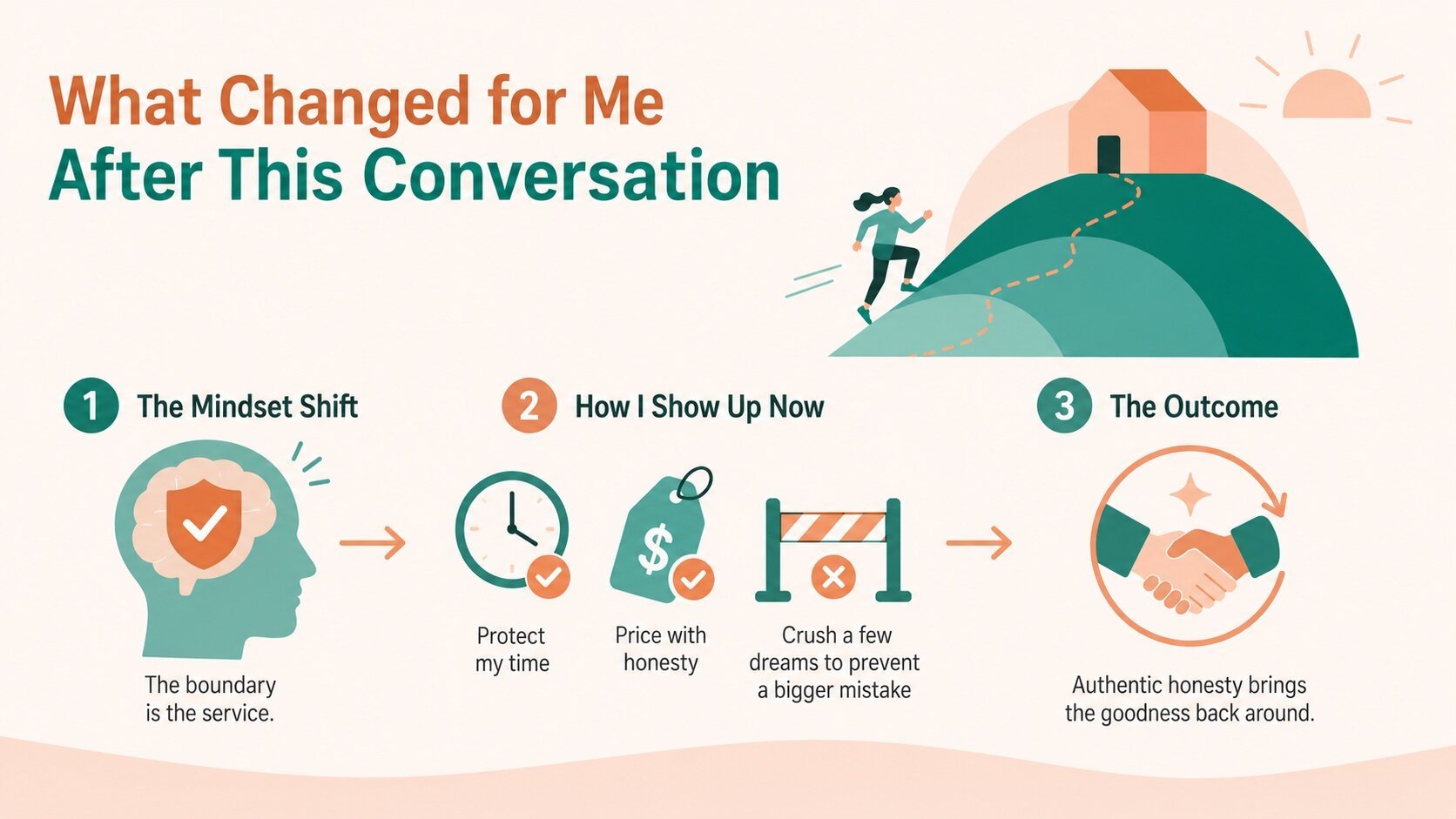
What changed for me is a renewed conviction that the boundary is the service. Protecting your time, pricing with honesty, and crushing a few dreams to save a client from a mistake are not soft skills. They are the job.
My conversation with Lauren Goché of Think Real Estate was a reminder that being authentically, sometimes inconveniently honest is what brings the goodness back around.
FAQ Section
How did Lauren Goché build her real estate team at Think Real Estate?
She built it out of necessity after hitting major burnout. With a coach's push, she hired a buyer's agent she now trusts to run buyer-side business. Then she added an operations manager and a transaction coordinator, which freed her to focus more on listings and finally take time off.
How does Lauren price listings in the Portland market?
She prices conservatively instead of baiting buyers with an artificially low number. Her standard is simple. She will not list a home unless the seller would genuinely accept the list price, which keeps the whole process honest.
Why does Lauren push back on buyers waiving inspections?
Because waiving inspection exposes the buyer to hidden problems, distorts the market, and creates real liability. She rarely allows non-contingent offers. She will even arrange a pre-offer inspection when the market forces buyers to compete hard.
Where can I learn more from Lauren Goché of Think Real Estate?
You can connect with Lauren Goché of Think Real Estate through her website at laurengoche.com or follow her on Instagram, where she shares listings and her candid take on the Portland market.
Keep the Conversation Going
If you want an honest, boundary-first take on building a real estate career that lasts, then follow Lauren Goché.
🌐 Website → https://www.laurengoche.com/
📘 Facebook → https://www.facebook.com/laurengocherealtor/
📸 Instagram → https://www.instagram.com/laurengoche/?hl=en
🔗 LinkedIn → https://www.linkedin.com/in/lauren-goché
If something in this episode made you think, question, or laugh, don't let it stop here.
🎙 Follow Andrea Gordon – REalizations Podcast:
🌎 Website → https://andreagordon.com/
📘 Facebook → https://www.facebook.com/AndreaGordonRealEstate/
📷 Instagram → https://www.instagram.com/andreagordonrealestate/?hl=en
🔗 LinkedIn → https://www.linkedin.com/in/andreagordonrealestate/
Apply to Be a Guest on REalizations
If you serve the real estate industry — through staffing, lending, brokerage, technology, or advisory — and help agents grow smarter, not harder…
Let's spotlight your insights.