If you are an investor or a self-employed buyer, you have felt this moment. Your deals are solid, your net worth is real, and a conventional lender still slides the file back across the desk and says no. The reason usually has nothing to do with your actual wealth. It has everything to do with how your income is structured on paper. In this episode of theREalizations Podcast, I sat down with Aaron Marsh of Marsh Lending to break down how creative financing gets these borrowers funded.
After 30 years in real estate, I have watched too many strong buyers lose good deals at the financing stage. Aaron is the Founder and President of Marsh Lending, and he spends his days building loans for the exact people banks turn away. Whether you are browsingOakland and Berkeley real estate homes for sale listings or eyeing an investment property three states away, the financing behind the deal is what makes it real.
Here is what you will take from our conversation:
●How DSCR loans qualify a property on its rental income instead of your paycheck
●When non-QM financing makes more sense than a conventional mortgage
●How high-net-worth investors structure deals through LLCs and trusts
●What over-leveraged investors can do to keep buying
●Why insurance has become a real obstacle in states like Florida and California
Check out the highlights here:
Why I Had This Conversation with Aaron Marsh of Marsh Lending

I started theREalizations Podcast because after a long career in real estate, I felt the work was profoundly misunderstood. Financing sits right at the center of that misunderstanding. Good deals live or die at the loan stage, and most people only ever know the single lane their local bank offers.
That is why I wanted Aaron on the show. He is the Founder and President of Marsh Lending in WaterColor, Florida, and he provides national residential, commercial, and investment financing. He works with self-employed professionals, business owners, and investors who need a path a standard bank cannot offer. His background is 30 years in corporate America and an MBA in corporate strategy, and he has built a niche serving high-net-worth borrowers whose income is anything but simple.
Watch the full conversation here:
That complexity is exactly where our conversation really started.
Financing That Follows the Property, Not the Person
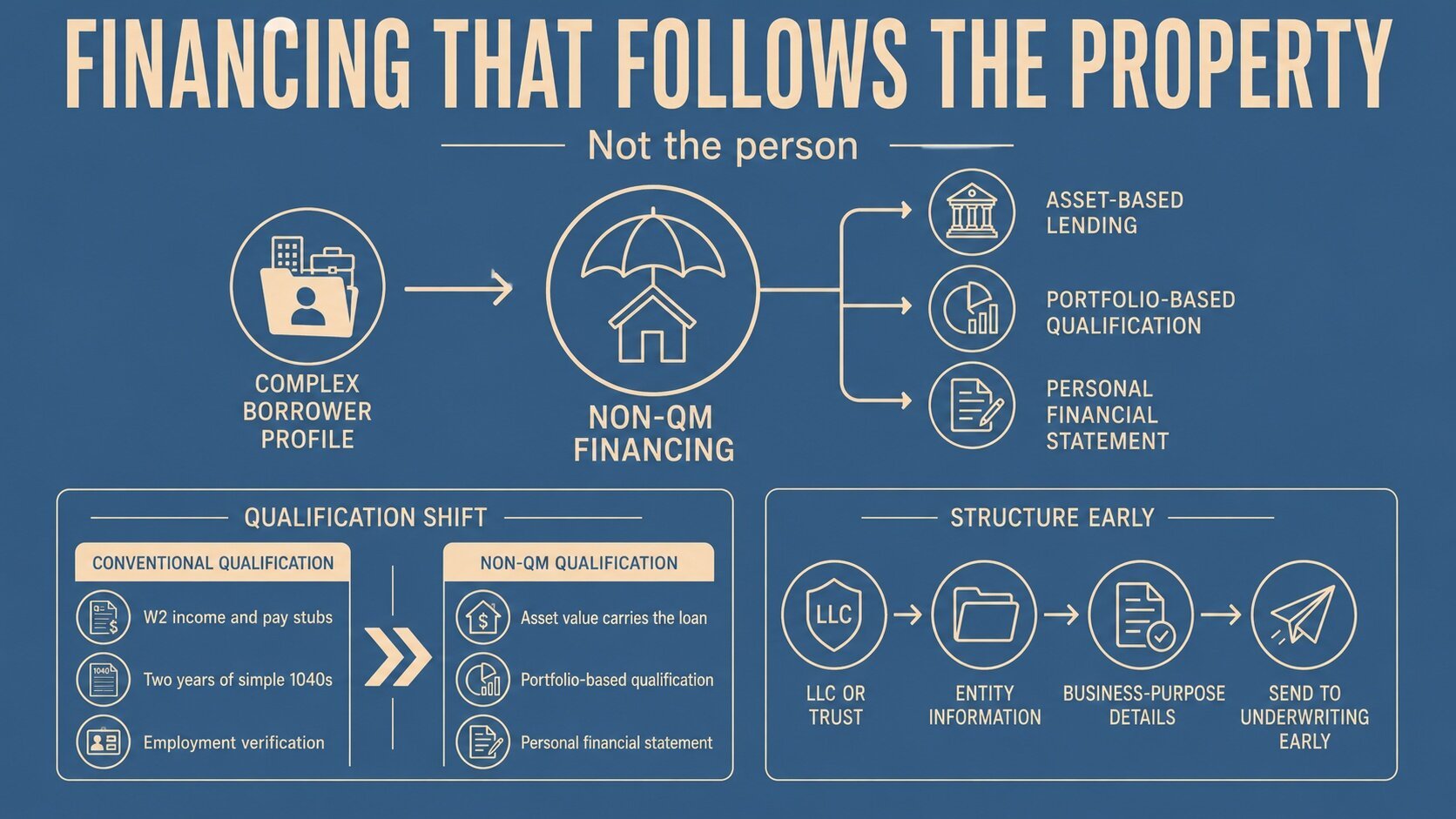
For high-net-worth and self-employed borrowers, income does not sit in one clean place. It is spread across LLCs, trusts, and hundreds of pages of tax returns. As Aaron explained in the episode, the answer is to stop qualifying the person and start qualifying the asset.
This is where non-QM financing comes in. Think of it as the umbrella that covers everything outside a standard bank loan. Under it sits asset-based lending, where the property value carries the deal, along with portfolio-based and personal-financial-statement qualification. As Aaron said in the podcast, if a borrower has the money in the bank to cover the property over five years, you check the note and move forward.
"A lot of high-net-worth clients don't have a simple financial profile with a W-2, two years of tax returns, and straightforward 1040s. Their returns can run hundreds of pages. I often think of one client who owns 17 LLCs. They have substantial assets, but their finances are far more complex. In those situations, it's important to work with a lending partner who understands how to structure financing appropriately—someone who can evaluate company income, personal income, and, when possible, focus more on the property's strength than just the individual's tax returns."
– Aaron Marsh, Founder & President, Marsh Lending
Conventional Qualification | Non-QM Qualification |
|---|---|
W2 income and pay stubs | Asset value carries the loan |
Two years of simple 1040s | Portfolio-based qualification |
Employment verification | Personal financial statement |
Once the loan is built around the property, one specific tool does most of the heavy lifting.
How DSCR Loans Actually Work
DSCR loans are the workhorse of this world. DSCR stands for debt service coverage ratio, and Aaron described it with a picture I keep coming back to. Think of a seesaw.
On one side sits the debt tied directly to the property. Add up the top four costs. On the other side sits the projected rental income, whether that comes from a long-term lease or a short-term Airbnb setup. If the income side clears the debt side, the loan qualifies.
●Debt side: principal and interest, homeowners insurance, property taxes, and any HOA or condo fees
●Income side: projected long-term lease income or short-term rental income
●The test: when the income outweighs the debt, the seesaw tips and the loan checks out
Here is the example from the episode. Say the property costs roughly $5,000 a month to carry, which works out to about $60,000 a year. The projected rent comes in around $75,000 a year in gross income. The rental clears the hurdle, the seesaw tips in the borrower's favor, and the loan checks out.
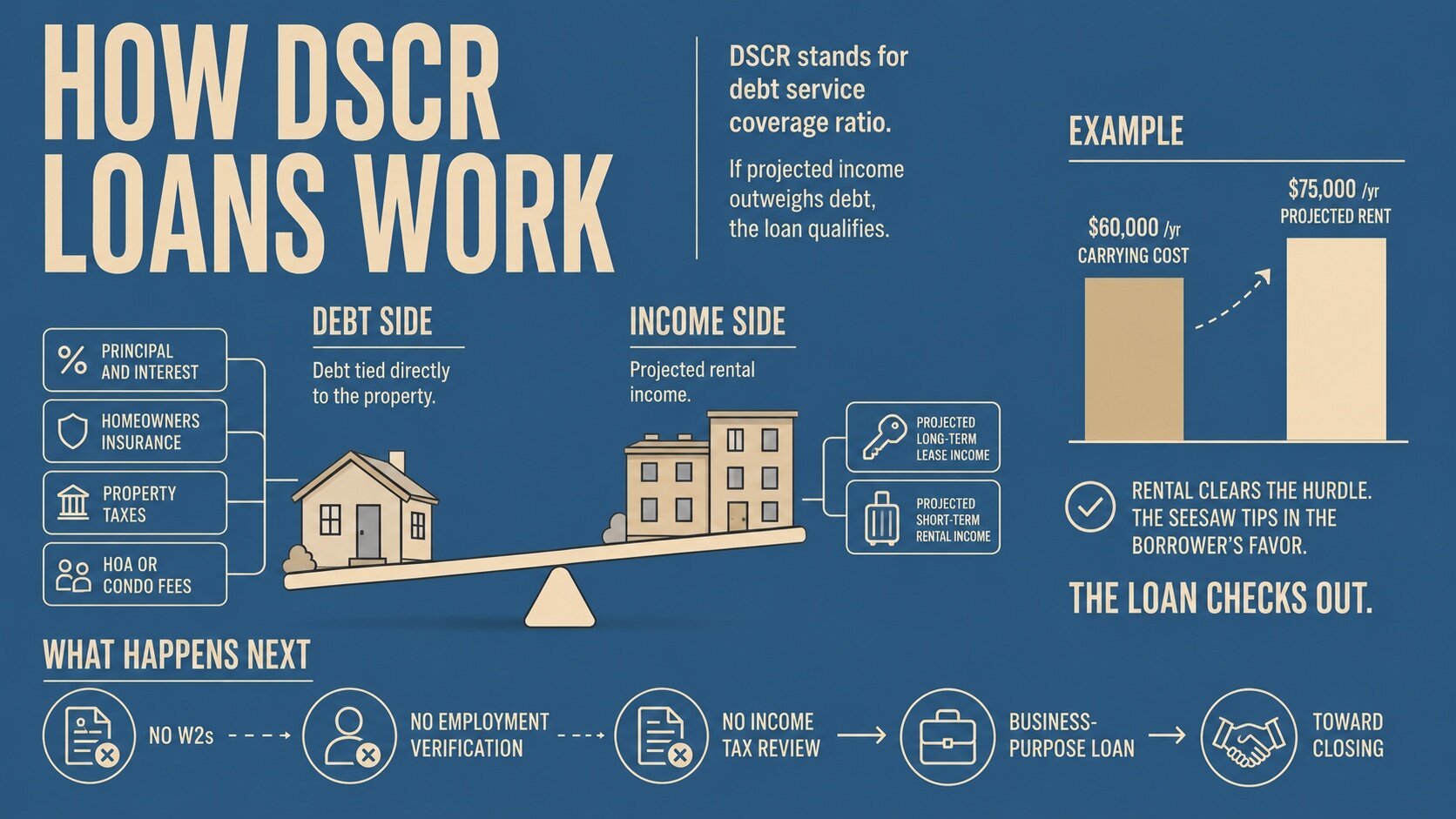
What happens next is the part investors love. No W2s. No employment verification. No income tax review. It becomes a business-purpose loan and moves straight toward closing.
"That will qualify the loan, and we haven't looked at your W-2s. We haven't verified your employment. We haven't pulled your tax returns or asked for income documentation or bank statements. At that point, we're essentially off to the races—we've already qualified the loan."
– Aaron Marsh, Founder & President, Marsh Lending
That works beautifully for a clean deal. It matters just as much for the investor who is already stretched thin.
Keeping Over-Leveraged Investors in the Game
Being over-leveraged does not mean you are out of options. As Aaron explained, even a high-net-worth investor with too much tied up elsewhere can keep moving. With proof of funds and a down payment, one of his lending partners will go up to 75% LTV, usually on an ARM product like a 3/1, 5/1, or 7/1.
When the numbers are tighter, hard money loans enter the picture. Aaron is honest that hard money is not cheap money. There is a higher interest rate and a few points on the front end. But used correctly, it works as a short-term bridge rather than a permanent solution.
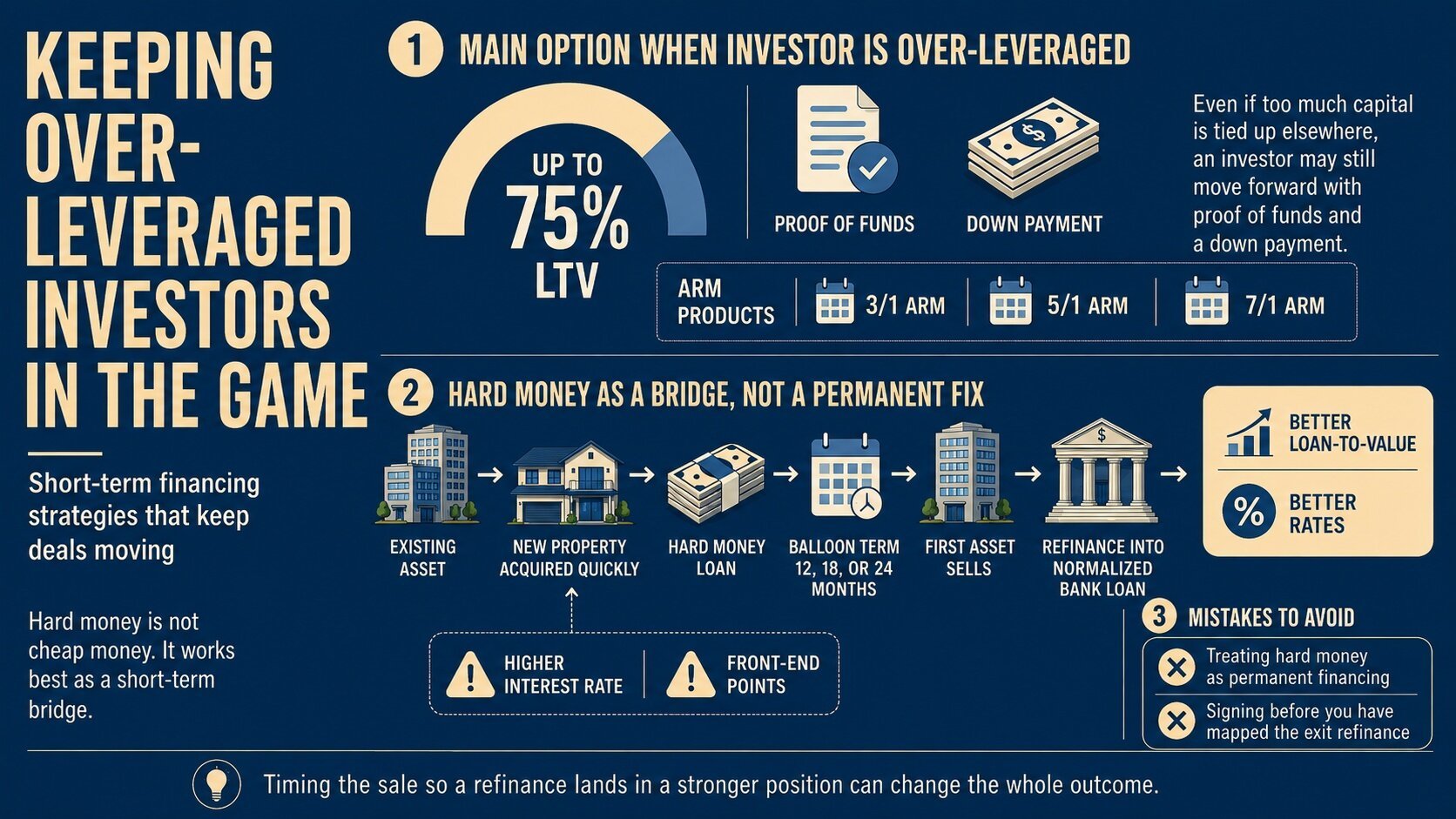
Here is how the bridge works in practice. Say an investor owns a large office complex and wants to grab a property that just came on sale. A hard money loan puts the new property under their name or LLC right away, often on a 12, 18, or 24-month balloon. While that first asset sells down, they hold ownership. When it sells, they refinance into a normalized bank loan with better loan-to-value percentages and better rates.
A couple of mistakes to avoid with this play:
●Treating hard money as permanent financing instead of a short-term bridge
●Signing before you have mapped the exit refinance
That same logic shapes how I help clients on the other side of a deal. When I walk sellers through myBay Area real estate seller services to list your home, timing the sale so a refinance lands in a stronger position can change the whole outcome.
By the end of our conversation, my whole framework for real estate investment financing had shifted.
What Changed for Me After This Conversation
I came into this episode thinking about products. Aaron reframed the whole thing as strategy. His team, from him down to processing, is not asking which of five or six off-the-shelf loans a borrower fits. They are asking what structure actually serves the client best.
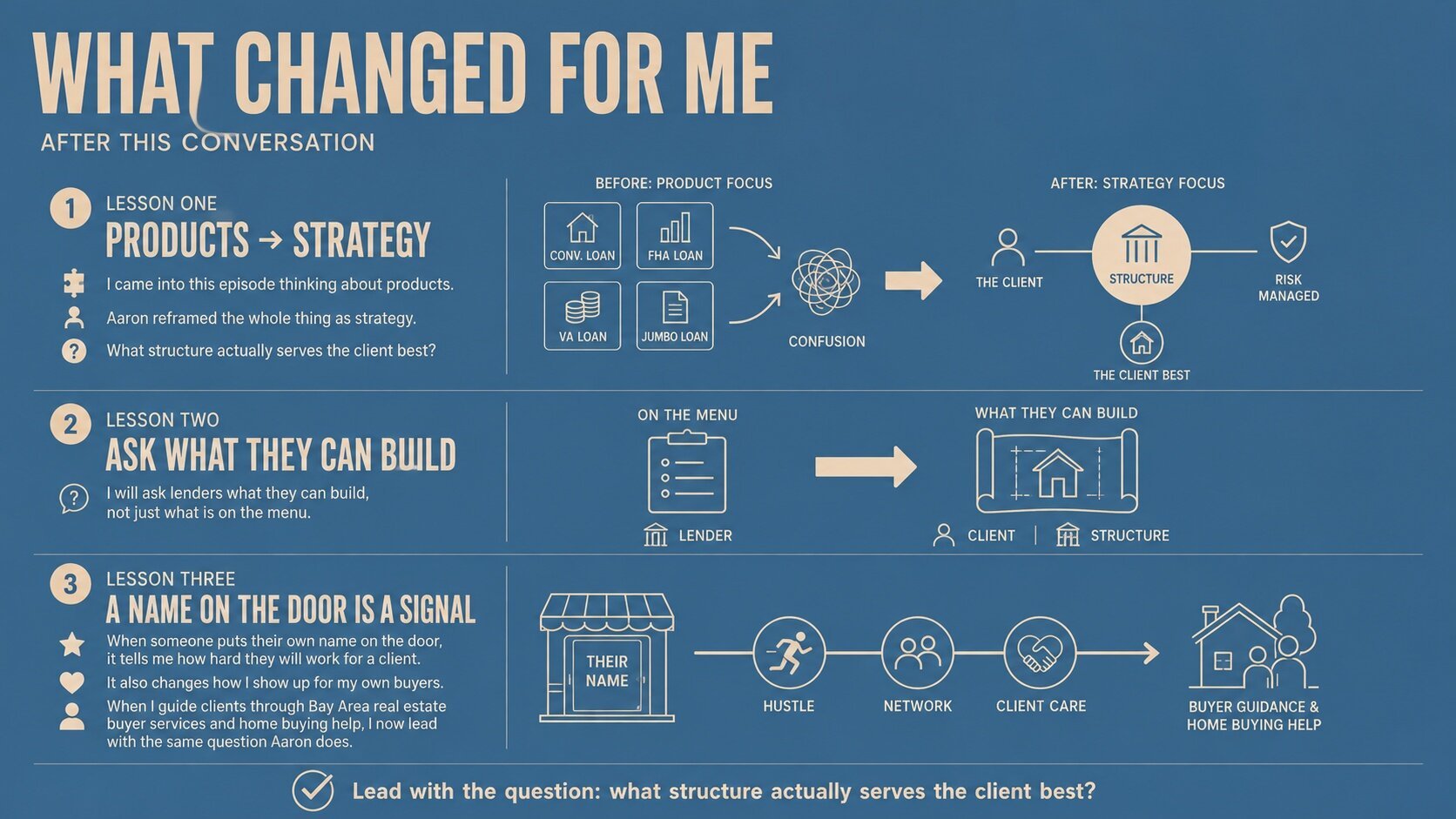
That changed two things for me. First, I will ask lenders what they can build, not just what is on the menu. Second, I will treat the reason behind a business as a signal. When someone puts their own name on the door, it tells me how hard they will work for a client. It also changes how I show up for my own buyers. When I guide clients throughBay Area real estate buyer services and home buying help, I now lead with the same question Aaron does.
<blockquote> "I could have named it, we're located in Florida, I could have named it Blue Ocean Mortgage, easily. Putting my name on it is that extra little poke to get out of bed, get out there, hustle, make the right connections, continually grow your network. As my wife says, your network is your net worth." — Aaron Marsh, Founder and President of Marsh Lending </blockquote>
FAQ Section
What is a DSCR loan, and who is it best for?
A DSCR loan qualifies a property on its own rental income rather than your personal income. It is built for investors, self-employed buyers, and anyone whose earnings are spread across LLCs, trusts, or complex returns, because it skips W2s, employment verification, and tax review.
When does a non-QM loan make more sense than a conventional mortgage?
When your wealth does not show up cleanly on a standard 1040. Non-QM covers asset-based, portfolio-based, and personal-financial-statement qualification, which lets high-net-worth and self-employed borrowers get funded on the strength of the property or their assets rather than a simple pay stub.
Why has insurance become such a hurdle in states like Florida, Texas, and California?
Aaron describes the market as an accordion. Storms squeezed carriers out from roughly 2020 through late last year. Capacity is opening back up as new players re-enter, but coverage is not cheaper or simpler yet. In markets like Northern California, major carriers have pulled out entirely, which can stall a loan if insurance cannot be secured.
Keep the Conversation Going
If you want strategic financing for residential, commercial, or investment real estate, follow Aaron Marsh of Marsh Lending. If something in this episode made you think, question, or laugh, do not let it stop here.
Connect with Aaron Marsh:
●Website →https://marshlending.com/
●LinkedIn →https://www.linkedin.com/in/aaron-marsh1/
●Facebook →https://www.facebook.com/marshlending
●Instagram →https://www.instagram.com/marshlending/
●YouTube →https://www.youtube.com/@MarshLending
●X →https://x.com/MarshLending
Follow Andrea Gordon – REalizations Podcast:
●Website →https://andreagordon.com/
●Facebook →https://www.facebook.com/AndreaGordonRealEstate/
●Instagram →https://www.instagram.com/andreagordonrealestate/?hl=en
●LinkedIn →https://www.linkedin.com/in/andreagordonrealestate/
Apply as a Guest on the REalizations Podcast
Real estate financing is shifting fast. Capital is moving, insurance markets are tightening, and the investors who win are the ones who understand their options. If you serve the industry through lending, brokerage, development, or finance, and you are solving real problems, I would love to hear from you.